Every Friday, “Science and the Sacred” features an essay
from a guest voice in the science and religion dialogue. This week’s guest entry was written by Karen Strand Winslow, Ph.D., a Professor of Biblical Studies at the Graduate School of Theology, Azusa Pacific University.
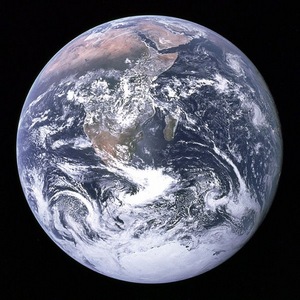
When we read Genesis 1.1: “in the beginning God created the heavens and earth” we picture the origin of the atmosphere, space, solar systems, and galaxies. We think of the creation of the planet in our solar system named “Earth,” whose shape is an oblate spheroid or a rotationally symmetric ellipsoid. This mental picture is natural, because the English term “Earth” is the name of the planet in this solar system on which humans reside. But in Genesis 1 “earth” does not mean the planet Earth. Genesis reports the origin of the “heavens and earth” as such terms meant in the author’s time and within his worldview, which did not include a twenty-first century acquaintance with astronomy. What does “earth” mean in Genesis 1? The answer is provided in the text itself.
Genesis 1.1 “In the beginning God created ha-shamayim and ha-aretz [earth].” Genesis 1.1 is a title for what is to follow. Genesis 1.2a “The earth [ha-aretz] was without form and void” (there was no earth yet). After God created light, named day and night, and made a firmament (the heavens or sky) to divide the waters, God made ha-aretz.
Genesis 1.9 “And God said, ‘Let the waters under the sky [ha-shamayim] be gathered together into one place, and let the dry land [ha-yabbashah] appear.’ And it was so. 10 God called the dry land eretz [English: “earth”] and the waters that were gathered together he called seas. . . . “
Ha-aretz is “dry land” [Hebrew: ha-yabbashah]. God created land from which seed bearing plants and fruit trees would emerge and on which the creepers would creep. To the biblical writer, this land was not a planet or a globe spinning on its axis or orbiting the sun along with other planets.
Genesis 1 explains the origins of the land on which people live, farm, and travel. Ha-aretz is often a synonym for ha-adamah, “ground” in the Bible. Throughout the rest of Genesis, the biblical writers use ha-aretz to describe one’s homeland, property, farmland, other regions, and bowing to the ground. Eretz is translated by the English term “earth” 660 times, and usually it refers to ground, soil, or the place where one is standing. In these cases, eretz is a synonym for the Hebrew adamah, the stuff from which adam is made in Genesis 2.7. The same term is translated by the English “land” or “country” 1,620 times in the Revised Standard Version, meaning location or place, boundaried or unboundaried, as in countryside. In addition, ha-aretz can mean the realm of all creatures, the realm or habitation of the living (Job 28.13; Psalm 27.13). Nowhere in the Bible does “earth” refer to a planet. Why is this important for science and theology?
Ha-aretz translated properly as “land,” takes the air out of controversies over whether the Genesis flood story depicts a local or “universal” flood, an aspect of the polemic of young earth theorists and “creationists.” (They suppose the earth to be less than 10,000 years old, based on adding the genealogies of Genesis. This is mixing genres–categories of literature–to develop a Western and even mathematical role for the Bible, while genealogies appear to link Abraham to Noah and Noah to Seth).
The term “universal flood” usually means that flood waters covered the entire planet. According to young earth theorists, the one-year Genesis flood laid down millions of layers of sediment across the planet, causing the earth to appear to be millions of years old. The basis of the young earth claim is the phrase “kol ha-aretz” in Genesis 7.3 and 8.9 and translated as “the whole earth.” For readers who have a planet in mind, this translation biases them to believe the text claims Noah was saved from a global flood.
But the flood story of Genesis 6-9 assumes the same worldview represented in Genesis 1 and uses the same vocabulary throughout, including ha-aretz to mean land or dry ground. Throughout the flood account in Genesis, eretz and adamah are used synonymously. “Kol ha-aretz” means all the land known to the originators of the flood story, perhaps a location around the Black or Mediterranean Seas, which would have been the “world” of the biblical writers. Although flood stories exist among some ancient cultures and evidence for flooding is apparent in some areas around the world, some regions have no stories or traces of flooding. The layers of sediment and fossils in North America alone demonstrate without question that a single flood could not have deposited them. The ancient texts and artifacts of Ugarit, Egypt, and Japan contain no flood narratives, and there are only a few from Africa. Thus, the closest neighbors of Israel do not “remember” flooding.
Neither is there geological data to support a global flood around ten thousand years ago. Eight times more water than is now on earth would have been required for waters to cover the planet. There would have been the need for a new creation to restore the earth after the flood, because salt water destroys vegetation. Certain geological phenomena would have been destroyed if there had been a global flood. In Auvergne, France, there are cones of scoria and ashes from long extinct volcanoes, but there are no signs of effects of water. In addition, the 35,000 year old cave drawings from the Dordogne area of France (and countless other extant artifacts) would have been destroyed by a global flood.
The Bible was not intended as a primitive science manual that presented rudimentary scientific facts that would be verifiable at a later date when science caught up. When the biblical writers refer to “all the land” or even “the whole world,” they refer to their whole world, not ours; they were not thinking of a planet, because they did not know they were living on a planet.
By observing the known world in all its magnificence–noticing, distinguishing, and naming its grandest features–Genesis 1, Psalm 104, Job 38 and Isaiah exemplify fundamentals of science–observation and organizing, but they are primarily theological. They cause us to worship God, as creator of all that is.
 Read Previous Post