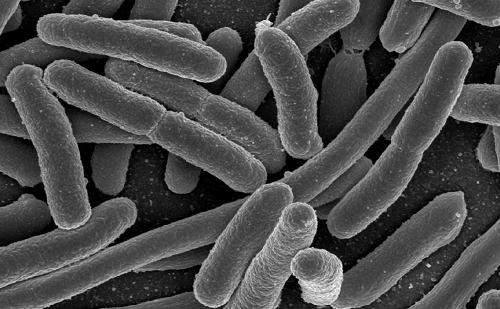
Twenty-one years and 40,000 generations later, an experiment looking at the evolution of a population of single-celled E. coli bacteria has finally reached its conclusion. The results “beautifully emphasize the succession of mutational events that allowed these organisms to climb toward higher and higher efficiency in their environment,” says Dominique Schneider, a molecular geneticist and member of the research team. More importantly, the study offers new insights (and also raises new questions) about the relationship between adaptive evolution, random mutations, and the genome.
The scientists began the experiment with a cultured population of fast-reproducing E. coli bacteria, freezing samples of the population at fixed points to compare their genomes to previous and future generations. While Darwin’s theory of natural selection has been extensively tested and supported in various ways over the years, never before has it been studied for so many generations and in such enormous detail.
By the midpoint (20,000 generations), the team found 45 mutations in the surviving bacteria. Just as Darwin’s theory proposed, these mutations did indeed confer some advantage to the bacteria. Thanks to advances in genome sequencing since the project began 21 years ago, the team was able to precisely see which mutations were beneficial and how they improved adaptation of the cells to their environment. Says Michigan State University professor and team member Richard Lenski, “It’s extra nice now to be able to show precisely how selection has changed the genomes of these bacteria, step by step over tens of thousands of generations.”
However, later generations of the experiment showed that the relation between mutations and adaptations is not always in a predictable equilibrium. A mutation which altered DNA metabolism around generation 26,000 led to a massive jump in mutations, even though the rate of adaptation was beginning to slow. By the final generation, the number of mutations increased to 653, and many of these were likely neutral and had no impact on the adaptability of the bacteria to their environment.
40,000 generations and 20 years seems like a long time to study the changes in a single type of cell. However, this represents 1/3,000,000,000th of the time and a much more miniscule fraction of the organisms which would have existed prior to the first multi-cellular organisms on earth. We know so little and yet we have learned so much.
The team plans to continue their study on the tiny bacteria, but the results, as collaborator Jeffrey Barrick notes, show “an astounding amount about the details of evolution in these little Erlenmeyer flasks.”
The full paper can be accessed online through the journal Nature (with a paid subscription).
 Read Previous Post