Science and the Sacred

One Hundred and Fifty Years...and Counting

Monday November 30, 2009

Categories: Weekly Feature
Thumbnail image for Origin_of_Species.jpg

Every Monday, "Science and the Sacred" features an essay from one of The BioLogos Foundation's co-presidents: Karl Giberson and Darrel Falk. Today's entry was written by Darrel Falk.

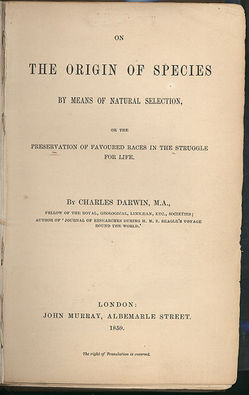
This past Tuesday marked the 150th anniversary of the publication of Origin of Species, undoubtedly one of the most influential books of all time. It seems there have been dozens of Darwin conferences this year commemorating not just the publication of the book, but also the 200th anniversary of Darwin's birth on February 12, 1809. Most biologists, including myself, would likely consider Darwin to be the most thorough and insightful biologist in history. As a biologist, and as a Christian committed to seeking truth, I believe there is much to celebrate during this anniversary year.

On the day before the official anniversary, I was talking with a friend who had attended one of the Darwin conferences. The meeting had included some of America's most well-known experts, who weighed in on the social ramifications of the 150 year old evolution/creation debate. My friend told me that the experts at this conference had been somewhat stumped when someone in the audience asked how it could be that when faced with the enormous amount of data in support of Darwin's theory, good honest thinkers could remain young earth creationists--a line of thought so out of touch with scientific reality. I was somewhat incredulous that the experts would have been stumped by this question. Perhaps I'm the one who is naïve, but to me the answer is simple. As I see it, all it takes is a couple of one-on-one dinner conversations with a couple of articulate persons and I think you come to understand their dilemma.

I am going to discuss three people with extremely impressive academic scientific credentials who believe in a young earth. They all have something in common and, even though these three individuals know the science much better than most in our society, I think they epitomize why millions of evangelical and fundamentalist Christians refuse to blink in the face of the mass of scientific data. Since some of what I will write is based on informal conversations over a meal, I have decided not to name them. I hope you will see that I deeply respect each one of them.

I met Person A at a conference in Kansas City eleven years ago. He was the only young earth creationist in attendance and I admired his courage to stand up for what he believed to be right, even though he was the only one who thought that way. "A" obtained his Ph.D. in paleontology at the nation's most prestigious university with one of its most prestigious scholars. He knows the science very well and he knows how compelling the scientific data is. However, at this Kansas City conference he told us that no matter how strong the scientific data seemed to be, he was confident that it would eventually prove to be false. "Right now, we who hold the young earth perspective are losing," he said, but he was staking his life and career on the premise that eventually the tide would turn. His faith in the literalness of the Genesis account trumped all else. Why? He told us that all that brought him meaning was grounded in the literalness of Scripture. Change the interpretation of the first three chapters of Genesis, he believes, and the entire Bible disintegrates, and with that disintegration so also goes all aspects of his purpose in life. So from his perspective when the Bible and science disagree, it is science that will eventually be shown to be incomplete, not the Bible.

Person B, like "A," has extremely impressive academic credentials. He is well-trained in the field of population genetics and served as a professor in plant genetics at a university which has a long tradition of being the world leader in this discipline. He is also the inventor of a very important biotechnology tool. I had a most enjoyable dinner conversation with "B" as part of a small one day meeting we attended in Pittsburg in July, 2008. "B" told me of his journey from agnosticism/atheism to theistic evolution, to "big tent" intelligent design, until he finally ended up as a young earth creationist. "In essence," he told me, "I choose young earth creationism because it allows me to engage the Bible in a manner that results in my feeling closer to God." Like "A," he acknowledges there is overwhelming supportive data for an old earth and evolution. Like "A," he believes it will be possible to identify holes in the evolution arguments and he is working optimistically at identifying them. I loved being with "B," for reasons that had nothing to do with his science, but everything to do with his warm Christian spirit. Except for my feelings about the quality of his science, being with "B" was a wholly positive experience. "B" has ultimately decided that God speaks through scripture in ways that are literal and not figurative. If we try to force the Bible to conform to scientific interpretations, he feels, we gain credibility with the world, but we lose the faith element that holds us close to God. He chooses the latter, and is convinced that the data will eventually catch up to the Bible.

Person C is another young earth creationist with very strong credentials. He has a Ph.D, in the history of science from another of the world's best universities. "C" was one of about 16 persons at a small one-day meeting I attended in Chicago in July 2007. I didn't have the good fortune of sitting down for a meal with him like I did with "B, or going for a short one-on-one walk as I did with "A." However, I did sit across a table from him for several hours and felt that I came to understand his heart, as well as his mind through the words that he spoke. At one point, the tears started to flow as "C" described that his one and only desire was to be thinking in a way and acting in the a manner consistent with what he sensed God wanted of him. Choked with emotion and unable to talk for awhile, he eventually told us he would step away from his position in a "second," if he became convinced that is what God wanted of him. I have no doubt he would. With theological reasons as his motivation, he genuinely thinks that he can find flaws in the scientific data. Theology and his personal relationship with God trump the science. The science, as he sees it, will eventually come around.

Each of these individuals believe as they do, not because of scientific data--they all realize how strong it is--it is their view of the Bible and the concomitant theology which drives their thinking. Their purpose and meaning in life is deeply embedded in a particular view of Scripture. Their relationship with God is deeply embedded in that view. Their hopes and dreams for their children and grandchildren are steeped in the view provided by this tradition. If you rip that view away from them, you rip away their compass and they would have nowhere else to turn.

So I am a little surprised that leading secular scholars find it difficult to understand why these individuals and their many followers hold fast. Each of us need to get up in the morning with some sense of purpose, and even these three individuals with minds that are as sharp as the secular scholars themselves are convinced that they have had a life-changing encounter with Jesus Christ consistent with what is revealed to them through Scripture. They know of no way to hold on to that conviction while at the same time accepting the science that seems to contradict. Given that choice, they choose Scripture over science. They are more certain of their relationship with Christ, as grounded in Scripture, than they are of the findings of science.

So we at The BioLogos Foundation cannot focus purely on the "Science" in Science and the Sacred, nor can we focus purely on the "Bio" in BioLogos. Every bit as important to our discussion is the "Sacred" is the "Logos." We have to show people in ways that really make sense that the tenets of evangelicalism don't stand or fall on whether we accept 150 years of data from evolutionary biology and 180 years of data from geology. With that in mind, we are delighted to announce that beginning tomorrow, Harvard-educated evangelical biblical scholar Dr. Peter Enns is officially joining the BioLogos team and will be especially involved in working with us on our Science and the Sacred blog. Clearly there are two important components to our work. One is to communicate the solidity of the scientific data. Together with our many scientific colleagues, Karl and I will continue to work on that. The other, however, is every bit as important. We want to remain faithful to Scripture as the inspired Word of God and to the living Christ through whom all things are created and in whom all things are held together. We need a biblical scholar to help us communicate this message well. Welcome Pete. We believe your availability is not just happenstance, and we are delighted to work alongside of you.

Share |
Advertisement
Comments
Paul Burnett
December 1, 2009 7:46 AM

"Karl A" asked: "What is a little trickier is when YEC is enshrined as part of an organization’s doctrinal statement. They’re not saying you have to believe this to be a Christian, just to be part of this organization… What does one do in a situation like that?"

Don't join the organization, if scientific illiteracy is that disturbing to you. After all, if the organization is that delusional about science, they may be similarly delusional about other parts of reality. A century or two ago there was an excuse for that kind of ignorance, but that is no longer the case - reality deniers, or as Richard Dawkins puts it, history deniers, have no excuse for their scientific illiteracy unless they're stupid, wicked or insane.

Paul Bruggink
December 1, 2009 7:49 AM

Good points well stated, Karl A.
And I hope Amazon is able to get Peter Enns' "Inspiration & Incarnation" to you quickly. It is very good.

Mere_Christian
December 1, 2009 11:24 AM

There is nothing at all that supports "design" or YECism, and honesty requires a person to recognize that, at least if they pretend to have enough knowledge to expound upon these matters.

- Glen Davidson

///

ALL of creation proves design. Nothing cannot create anything. (0 x 0 = atheism.) DNA is not random. Isn't that the story line?

Look for the stubborn belief in idiocy among the "pig" headed atheist crowd. They're easy to find. Look for the trampled pearls and follow the trail to the self-identified "free" thinker. They'll all be in the exact same place all doing the exact same thing. Because, you know, they are "free" thinkers.

If the earth is "only" billions of years old, it is a young creation indeed. From timeless space, to mud, to monkeys, to man. Looking at godless behavior, you have to see the reality in that.

But anyway . . .

Give me a YEC, or a Bible-thumping preacher and the Christians that live that life, over a beer swilling dorm dwelling skeptic, or a smug and self-serving Humanist school employee anyday.

Less violence and vice is a good thing.


And BioLogos guys, you need to hire on Peter Kreeft.

Scott Jorgenson
December 1, 2009 9:01 PM

Knockgoats - To the extent witchcraft is scientifically testable we can rule on it using science. For example, whether spells have observable effect under controlled circumstances, is something for which science is really all we need. But the broader metaphysical claims of witchcraft - that there is a mystical and magical side to nature, emanating on some "higher plane" for example - are by definition impervious to scientific investigation, since the objects of those claims are posited to not to be wholly part of the observable, physical universe. Even claims about how we can interact with and be affected by magic in observable, physical ways within this universe are relatively impervious, if they are framed in such a way as to not be subjectable to controlled experiment (for example, by positing that spells only work when skeptics aren't watching for them).

So then the reasons we decide not to believe in witchcraft cannot be entirely scientific. They are metaphysical and philosophical as well. For example, we might consider that witchcraft, if it is indeed so slippery as to not be able to be pinned down, is also superfluous (ala Occam's Razor) and we might as well deem it not to exist on those grounds. That's a philosophical decision. Or we might think that the supposition of a world of innumerable competing and arcane magical powers, fundamentally impersonal and amoral, is haphazard and inelegant compared to, say, a classical monotheistic system. That's a theological judgment. We might look at the consequences of magical belief in adherents' lives - does it make them happier, does it make them better people than they would be otherwise, etc - and come to some opinion there (yes, I know this is consequentialist). All of these are other criteria that can come into play when finally deciding what we think about witchcraft, and we are fooling ourselves if we think that we are simply following where science leads.

As for killing young children, naturally the thought is repulsive and the act is evil, but why? Science cannot declare it to be evil, repulsive, or wrong; that is our moral intuition speaking (which yes, to some degree may have been formed due to certain selective pressures, but that itself does not offer scientific opinion on whether that moral intuition is right or wrong, good or bad). All science can do is comment on the effects within the physical world of acts within that world. Science could say that the murder of young children is detrimental to social cohesion and thus is likely to be selected against; on the other hand, science could also say that the murder by a male of offspring not his own (as in a troop or harem situation, like with baboons) is selectively advantageous. But it can't say whether it is evil.

So no I don't believe in witchcraft, and yes I agree that witchcraft leading to murder is awful, but it can't be science which entirely leads me there. Honestly, I don't really understand why New Atheists might have a problem with that. Science is methodologically bound to naturalism and cannot investigate the metaphysical -- this is something recognized by most philosophers I think, theistic and non-theistic alike. Its something that non-theists like Michael Ruse, Stephen Gould and Eugenie Scott are able to agree with us theists upon, so I really don't understand the controversy.

Well, it seems that now I am the one to have derailed a thread from the subject of the original posting. Sorry to all!

pds
December 2, 2009 10:05 AM

The Design Spectrum

This post is, I think, misleading. Falk suggests that the only reason why people doubt aspects of evolutionary theory is because of their reading of the Bible. It only profiles 3 people, and they all happen to acknowledge the "overwhelming" evidence for "evolution" (not defining what Falk and they mean by this). This ignores the very large number of Christians and agnostics who doubt aspects of evolutionary theory because of the science.

I would like to hear if Persons A B and C agree with his characterizations of them.

Person B sounds very much like John Sanford, professor at Cornell and inventor of the Gene Gun. James noted in a comment above that he thinks so too. If it is, then I think Falk has given a highly selective and very misleading portrayal of Sanford's views on the relevant science.

I have posted some quotes and a link on what John Sanford really believes about the relevant science:

http://thedesignspectrum.wordpress.com/2009/12/02/john-sanford-and-his-pilgrimage/

Read All Comments

Post a Comment

By submitting these comments, I agree to the beliefnet.com terms of service, rules of conduct and privacy policy (the "agreements"). I understand and agree that any content I post is licensed to beliefnet.com and may be used by beliefnet.com in accordance with the agreements.


Please type the text you see in the box below to verify your post and help us prevent spam. You have a limited time to type - you may wish to compose your comment in a separate document and paste it here upon completion.

Type the characters you see in the picture above.

Advertisement

Search This Blog

feed icon Subscribe

RSS Feed

Receive updates from Science and the Sacred

About the Authors

The BioLogos Foundation
The BioLogos Foundation promotes the search for truth in both the natural and spiritual realms, and seeks to harmonize these different perspectives.
» Posts by The BioLogos Foundation
Darrel Falk
Dr. Darrel Falk is Professor of Biology at Point Loma Nazarene University in San Diego, where he has taught since 1988. He is the author of Coming to Peace with Science: Bridging the Worlds Between Faith and Biology (InterVarsity Press, Downer's Grove, Il
» Posts by Darrel Falk
Karl Giberson
Dr. Karl Giberson is an internationally known scholar of science-and-religion and one of America’s leading participants in the creation/evolution controversy. He is the author of four books, including, “Saving Darwin".
» Posts by Karl Giberson
Pete Enns
Peter Enns is an evangelical Christian scholar, author of several books and commentaries, and Senior Fellow of Biblical Studies for BioLogos.
» Posts by Pete Enns
More »

About Science and the Sacred

Leaders of the BioLogos Foundation share insights on the latest ideas on science, faith, and their integration.

Advertisement

Advertisement


About Beliefnet

Our mission is to help people like you find, and walk, a spiritual path that will bring comfort, hope, clarity, strength, and happiness. More about Beliefnet.

Legal

Copyright © Beliefnet, Inc. and/or its licensors. All rights reserved. Use of this site is subject to Terms of Service and to our Privacy Policy. Constructed by Beliefnet.

Advertisement

Report as Inappropriate

You are reporting this content because it violates the Terms of Service.

All reported content is logged for investigation.