Science and the Sacred

Science and an Incarnational Approach to the Bible

Friday November 6, 2009

Categories: Guest Feature
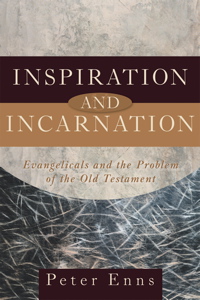
incarnation_inspiration.jpgEvery Friday, "Science and the Sacred" features an essay from a guest voice in the science and religion dialogue. This week's guest entry was written by Peter Enns. Enns is an evangelical Christian scholar and author of several books and commentaries, including the popular Inspiration and Incarnation: Evangelicals and the Problem of the Old Testament , which looks at three questions raised by biblical scholars that seem to threaten traditional views of Scripture. This is the first of a multi-part series.


The Problem

It is no secret that developments in modern thought have challenged traditional notions of the Bible--not simply how to handle a verse here or there, but how to think of the Bible as a whole. To say, for example, that the Bible is inspired or the revealed word of God is fine, but it does not really address the situation at hand, for it leaves unaddressed how we are to think of inspiration and revelation in light of these recent challenges.

Two of these challenges crystallized in the nineteenth century and are still very much with us today. In biblical studies, texts from ancient cultures surrounding Israel began to be discovered and deciphered, and these texts bore striking similarities to foundational texts of the Old Testament. The first and still most famous of these discoveries are stories of creation and the flood from ancient Mesopotamia that are older than the biblical account. Although there are important differences between the Genesis stories and these other texts, it quickly became very hard to escape the conclusion that the authors of all of these texts--Genesis included--share a conceptual world about the nature of reality; they "breathed the same air."

In subsequent generations, as archaeological studies shed more light on the ancient Mesopotamian world, the Old Testament came to be seen more and more as reflecting the environments in which those writings were produced. An entire field of inquiry arose called "The Bible and the Ancient Near East," or similar designations. It was clear that the Old Testament could be profitably set in its ancient settings, and doing so would yield a deeper understanding of the Bible and its world, even if it challenged some traditional views. This is not to say that the Old Testament is "just like" other ancient writings or could be understood merely on the basis of these comparisons. No two writings from antiquity can be so closely equated, and certainly the Old Testament has many distinctive marks. But the pressure point was the striking similarities.

It is beyond any reasonable debate that the various writings of the Old Testament reflect the ancient contexts in which they were written. The interconnectedness of the Bible and the ancient world can be both confirming of Evangelical instincts regarding the Bible, but also presents very important challenges concerning the uniqueness and historical content of the Old Testament, Genesis 1-11 being a particularly famous example. However one may think through the specifics of these challenges, the more basic point should not be lost: any move to articulate very important concepts like inspiration and revelation cannot blissfully ignore the circumstance described above, but rather must account squarely with the "ancient near eastern way" God chose to speak.

A second challenge to traditional notions of the Bible in the nineteenth century is well known to readers of this blog: Darwin and evolution. Here we have a way of looking at human origins that was persuasive to scientists, spread quickly, and, in tandem with advances in geology from the previous century, called into serious question whether Genesis 1-11--especially creation, the flood, and age of the earth--has any historical value whatsoever.

It was a tough century for Christians. Challenges were coming from the halls of academic inquiry, both biblical studies and scientific disciplines. For traditional thinking about the Bible, the dominoes were unraveling down the slippery slope, so to speak. And judging by the persistent resistance offered by conservative scholars during the latter half of the nineteenth century (particularly at Princeton Theological Seminary), the threat was very real indeed.

It is not at all an exaggeration to say that, for many, "attacking" the Bible in this way was nothing less than an "attack" on the gospel itself. It is fair to say that Fundamentalism and by extension Evangelicalism were born out of this conflict between older views and new discoveries. In my opinion, even though some of the dust has settled, the nineteenth century is a blow from which Evangelicalism has yet to recover--a point demonstrated by the very existence of the BioLogos project.

The work before Evangelicals is essentially one of synthesis. How can we (1) speak of the Bible as God's word while also (2) facing with integrity things like archaeological discoveries and advances in scientific knowledge of the world? This is an important, even vital, question to consider, for apologetic reasons as well as encouraging the faithful. How can we talk about God and the Bible now, in view of these circumstances?

I would like to suggest that a very helpful way of talking about the Bible that can account for the present challenges is what I call an incarnational model, where the nature of the Bible is understood on analogy with the person of Christ. As Christ is both completely divine and human, the Bible is a book that is both authored by God and by human beings. This has important implications for how we read the Bible, indeed, for what we expect from it.

In my next post I will define more clearly what an incarnational model is before we begin looking at specifics.

Share |
Advertisement
Comments
Martin Rizley
November 17, 2009 2:55 PM

Knockgoats,
You're wise not to place implicit trust in what I say (or in those scientists whom you seem to trust so implicitly-- after all, they are mere men, too, and fully capable of erring in their collective judgment-- if you doubt that, just check out what used to be the scientific "consensus" a hundred years ago concerning the thyroid and pituitary glands, and how thoroughly that "consensus" view has been discredited). A measure of skepticism is healthy, when it comes to the dogmatic declarations of fallible, finite, and foolish men. But you have no reason to doubt the testimony of Him who claimed to be "the way, the truth and the life," and who proved the validity of His claim by rising from the dead. My prayer for you, Knockgoats, is that someday, you will not only come to believe Him, but also to worship, love and serve Him as His willing "bondslave."

Knockgoats
November 17, 2009 4:20 PM

Martin Rizley,

I suspect I know a great deal more about the history of science than you do. I am well aware that scientists can err - but they are no more likely to turn out to be wrong about the broad facts of evolution and Earth history than they are to discover that the Earth sits on the backs of four elephants, resting in turn upon a giant turtle.

you have no reason to doubt the testimony of Him who claimed to be "the way, the truth and the life," and who proved the validity of His claim by rising from the dead.

Aren't you a bit old to be believing in fairy tales, Martin? There is no good evidence at all that he did any such thing, nor even that he claimed to be "the way, the truth and the light".

My prayer for you, Knockgoats, is that someday, you will not only come to believe Him, but also to worship, love and serve Him as His willing "bondslave."

You know, that's exactly the sort of language the masochist in a sado-masochistic sexual relationship would use, Martin. Still, since you worship an imaginary sadistic psychopath, I suppose it's appropriate. Not my scene, I'm afraid, but pray for me all you want. Tell you what - you pray for me, and I'll think for you. Deal?

Martin Rizley
November 17, 2009 8:18 PM

Knockgoats,
It's a deal (but you can be sure I'll keep thinking, as well as praying; it's impossible for believers to do otherwise.)

Knockgoats
November 20, 2009 6:29 AM

you can be sure I'll keep thinking, as well as praying; it's impossible for believers to do otherwise. - Martin Rizley

Oh, I don't deny that you think - in much the same way as someone confined to a treadmill can run!

OGEthics
December 16, 2009 6:58 PM

Nobody knows when the Second Coming is, only the Father. Hence, the "incarnation model" is perhaps the only way to articulate what we mean when we say "Word of God."

The second Jesus approach is creating a strong theological suspicion. Please understand the risk involved in being deluded in that false belief that you are Christ: a false Christ!

God knows this concept comes from his Holy Spirit once you receive him in baptism and consecrate yourself to the Lord. Like Paul and many others have said Christ lives in them, the level of commitment is what makes this embodiment of Christ in us with much or less intensity and reality.

The costs for following the Lord are conquerable; we are supposed to yield them as a wonderful sacrifice for the reward of eternal life. When we conquer them and accept they are not going to stop us anymore in our Christian mission, we might delude our conception of the only one savior Jesus Christ in our own benefit and get lost in error.

The second Jesus is that representation/incarnation of the Christ in action in our lives. We are called to be like him. The world needs us to be Jesus.

Read All Comments

Post a Comment

By submitting these comments, I agree to the beliefnet.com terms of service, rules of conduct and privacy policy (the "agreements"). I understand and agree that any content I post is licensed to beliefnet.com and may be used by beliefnet.com in accordance with the agreements.


Please type the text you see in the box below to verify your post and help us prevent spam. You have a limited time to type - you may wish to compose your comment in a separate document and paste it here upon completion.

Type the characters you see in the picture above.

Advertisement

Search This Blog

feed icon Subscribe

RSS Feed

Receive updates from Science and the Sacred

About the Authors

The BioLogos Foundation
The BioLogos Foundation promotes the search for truth in both the natural and spiritual realms, and seeks to harmonize these different perspectives.
» Posts by The BioLogos Foundation
Darrel Falk
Dr. Darrel Falk is Professor of Biology at Point Loma Nazarene University in San Diego, where he has taught since 1988. He is the author of Coming to Peace with Science: Bridging the Worlds Between Faith and Biology (InterVarsity Press, Downer's Grove, Il
» Posts by Darrel Falk
Karl Giberson
Dr. Karl Giberson is an internationally known scholar of science-and-religion and one of America’s leading participants in the creation/evolution controversy. He is the author of four books, including, “Saving Darwin".
» Posts by Karl Giberson
Pete Enns
Peter Enns is an evangelical Christian scholar, author of several books and commentaries, and Senior Fellow of Biblical Studies for BioLogos.
» Posts by Pete Enns
More »

About Science and the Sacred

Leaders of the BioLogos Foundation share insights on the latest ideas on science, faith, and their integration.

Advertisement

Advertisement


About Beliefnet

Our mission is to help people like you find, and walk, a spiritual path that will bring comfort, hope, clarity, strength, and happiness. More about Beliefnet.

Legal

Copyright © Beliefnet, Inc. and/or its licensors. All rights reserved. Use of this site is subject to Terms of Service and to our Privacy Policy. Constructed by Beliefnet.

Advertisement

Report as Inappropriate

You are reporting this content because it violates the Terms of Service.

All reported content is logged for investigation.