Their Bad Mother

Their Bad Mother

The Road To Heaven Is Paved With Maracas

posted by Catherine Connors | 9:30am Wednesday March 9, 2011

Last weekend, I went to Mass for the first time in well over a decade. To say that it was a strange and disorienting experience would be to understate things dramatically. But it was also a deeply comforting and familiar experience. I know that that doesn’t seem to make a lot of sense, but in my experience very little ever does when it comes to sorting out one’s personal relationship to faith.

I should maybe back up a bit.

I went to Mass because I was in San Antonio on a media tour, and the missions of San Antonio were part of that tour, and once I saw the missions – wandered their grounds, touched their walls, let myself be moved by the great stone carvings of angels and saints and crosses and the spirit of faith and mission – I decided that I needed to delve further into the experience offered there. If I was moved by the structures of the missions, would I be moved by the practice of faith that occurred therein? If I found myself drawn to the small prayer grotto devoted to the Virgin – and even moved so far as to murmur a little prayer there – might I not be drawn to the prayers and hymns sung in the chapels? Might this not be an opportunity to test my commitment to exploring faith?

Also, I heard there was a mariachi band at Sunday mass at Mission Concepcion. I decided to go.

I didn’t go comfortably. I’ve been resisting the Catholic Church – the appeal of its familiarity, the lure of memory, the attraction of returning to the bosom of the faith that defined the happiest years of my childhood – because I don’t want to like the Catholic Church. Everything that I loved about it as a child and a girl – the comforting rituals, the poetic words, the joyfulness of the hymns that were sung, to the accompaniment of acoustic guitars, in our hippy West Coast Irish Catholic parish – was gone, I thought – gone in spirit, anyway – and replaced by politics and controversy and all the terrible things that an adult mind and heart can’t ignore. I didn’t want to wrestle with that. If I was going to re-embrace a practice of Christianity – and that, I should note, has by no means been a given – I figured that it would probably be Anglican. Maybe United. But probably Anglican. I like the Archbishop of Canterbury.

So I went in the spirit of research. I went to observe and report to myself on my findings. I didn’t go to pray or to recite the Nicene Creed or to take Communion – not that I could take Communion, lapsed as I am – or to be blessed. I went to analyze.

I didn’t analyze. I prayed and recited the Nicene Creed and didn’t take Communion but approached the altar anyway with the other communicants and asked to be blessed by the priest – a friendly Texan who goes by ‘Father Jim’ – and fought back tears as he blessed me and prayed some more. I did get a little analytical during the Intercessions – I have mixed feelings about intercessory and petitionary prayer – but I still bowed my head.

And I sang. You can’t not sing when there’s a mariachi band strumming their guitars and blasting their trombones and singing with an almost manic glee about how wonderful is heaven! And how awesome the Lord! Such that for all my ambivalence about all things politically Catholic and practically Christian I joined in and sang in English and in Spanish – badly – and couldn’t keep from smiling as the band leader – sunglasses around his neck, trombone in hand – shouted Hallelujah! This, I thought, this is what it used to feel like. Sure, it was folk guitars and Dylan-inspired hymns and I was young and didn’t know from good music or bad, but it was happy. Joyful. It was a musical practice of faith that caused one’s toes to tap and one’s heart to lift. It was why I loved the Church. Because it made me feel joyful. It made me want to dance.

The mariachi Mass at Mission Concepcion made me feel that way again, for an hour or so.

I don’t know what this means for where I go from here in terms of figuring out faith. I can’t fly to San Antonio every weekend for mariachi Mass, and so far I haven’t found anything like that anywhere near to where I live. And I am, still, deeply troubled by the Church and its politics and I don’t know that that can be overcome with some trombones and cacarones.

But still, there was music. And I sang.

(You can read more about my trip – and get a chance to go to San Antonio yourself – over at Her Bad Mother.) 

Dear God (On The Catholic Church And Abuse And Evil And Crises Of Faith)

posted by Catherine Connors | 1:34pm Wednesday February 16, 2011

This weekend, I read an article in New York Times Magazine about the crisis surrounding the Catholic Church in Ireland as new, horrible, stories emerge about sexual abuse of children and efforts by the Church to cover up those stories. It was a teensy bit upsetting. So I started to write a post about it – in the middle of the night, fueled by outrage and tea – and realized, a few paragraphs in, that I’d already written that post. Like, last year, the last time that I was outraged about the Catholic Church. So I’m reposting it here, with the proviso that it should be read as articulating an outrage that increased by a factor of 10.

When I was twelve years old, I was confirmed in the Catholic faith.
The priest who  administered the rite of confirmation was a man that I -
in the manner of all judgmental twelve year olds who recoil at elders
who seem weird and smell bad – did not like, although I did not, at the
time, dislike him quite so much as I did the nun who led the weekly
catechism classes for young members of the Church. Sister Anne was
elderly, and terrifying; she wore her black habit like a suit of armor
and carried with her a old wooden ruler, the kind with blade-like metal
embedded along the outer edge, and she would menace us with it,
sometimes cracking it down upon the side of a desk when some unfortunate
child failed to list the Seven Sacraments on command. Sister Anne, my
classmates and I decided, was not on the Right Side Of God.

Nobody that frightening could be good, we told each other as we
congregated outside during a class break. God wouldn’t stand for it.
“She’ll be punished some day,” someone said. “She’ll go to hell.” That
thought was somewhat reassuring.

One of the boys disagreed. “God doesn’t seem to care all that much if
the priests are scary, so why not the sisters? And the sisters don’t
even do anything, not like the priests. He lets them” – he
practically spat the word – “be the bosses of the church.” A few of the
other boys nodded, and there was much shuffling of feet. Somebody
murmured something about creepy being worse than mean,
and a couple of the boys moved away from the group. “God doesn’t really
care about what those guys do. He just cares that we know the
sacraments,” he added. “It sucks.” I had no idea what he was talking
about, but I knew that I really didn’t like the way church felt
at this parish – a parish that my family had only recently joined,
after relocating – at this parish, with this priest and this nun and
these scared children, and it seemed to me that if anyone was to blame,
it was probably God, who was in charge of the whole business, as I
understood it.

Years later, my mother asked me, in a telephone conversation, if I
remembered Immaculate Conception, the church where I’d been confirmed,
and the priest who’d administered those rites. “I remember the sister
who taught my catechism more than him,” I said. “She was evil.”

“Well, not as evil as him, apparently. He’s been accused of abusing
some of the boys. You know”  – her voice dropped to a whisper -
“sexually.”

And I thought: well. That explains a lot.

I was in my early twenties by then, and it had been a couple of years
since I’d been to Mass. Religion was the opiate of the masses, Marx had
taught me, and my mother had gone ahead and confirmed what he and
Machiavelli and Nietzsche and the kids in the parish of Immaculate
Conception – and, we would someday learn, parishes everywhere – already
knew: that religion sometimes gives very bad people an opportunity to
very bad things, and to get away with it. So I abandoned religion,
mostly entirely.

By my early thirties, I was trying to get it back. Or, rather, I was trying to figure out whether I should
get it back. I had loved God, and the Catholic Church, for a long time,
before the unpleasantness of Immaculate Conception, and, later, my
parents’ separation and divorce and mutual crisis of faith (another
story entirely, although not one, perhaps, that is mine to tell). I
missed them, sometimes. And I worried, sometimes, about how I would
navigate the waters of faith once I had my own children; how I would
raise them to have faith, if I wasn’t – if we weren’t – at home in the
Church. Because I knew that I wanted them to have faith.
I just wasn’t sure how, and on what terms. I struggled to figure out
how to renegotiate my relationship to God and to faith. And even though I
told myself that I wanted to explore faith in all of its forms and consider all options, I have, deep down, always assumed that if I returned to church it would be to return to the Church, the Catholic Church.

I had sort of thought – this year after my father’s death, this year during which we need so much prayer for my nephew – that I might, this year, return for Easter. But then the Catholic Church went ahead and screwed it up and put me off religion, again.

Allegations of abuse within the Church are not new, of course. But
it’s not the allegations – the fact – that abuse occurred (horrifying as
that is) that are destroying the remnants of my faith in the Church:
it’s the Church’s refusal to take responsibility for it.
It’s the Church’s refusal to admit that mistakes were made, that it
failed to protect children. It’s the Church’s inability to be humble, to
acknowledge that the failure to protect children was a human failure,
one made within the Church, by the Church, and that it let God down.
That it let us down – that it let the children down – is
obvious. That it claims now to have God on its side, that it claims to
be on the side of what is good and right, and that it insists that all
those who express horror at what it allowed to happen are agents of
persecution who are needling them – and by extension, God – with their
evil accusations and petty gossip is a travesty of such magnitude that I
have trouble, in some moments, even believing that it’s happening. It
reads like the plot of a bad conspiracy-themed action novel, wherein
robed men give booming speeches about Protecting God’s Church At All
Costs while minor henchmen destroy documents and arrange for naysayers
to be ‘disappeared.’  Somewhere, Dan Brown is taking notes, furiously.

This is all so appalling, so terrible, because the Church’s refusal to take responsibility
for the horrors committed on its watch and its refusal to take
responsibility for not addressing and eliminating those horrors when it
could makes it seem as though, in the words of my young fellow
catechumen, “God doesn’t really care about what those guys do.” When the
Church insists that the reputation of the Church is more important than
the well-being of innocents, when the Church puts the Church first and
insists that this is what God wants it to do, God is on its side, if you criticize it you criticize God and also Jesus and all the saints and probably your grandmother, too,
well, it sets itself up as the earthly representative of a God that no
good person should want to follow. And in so doing, it destroys faith.
Or, at least, it shakes it really violently.

The more reasonable explanation, of course (assuming, that is, that
you believe in God), is that the Church is not representing God. Or that
the men who are running the Church, and the men responsible for not
purging the Church of the sickness within it, are neither representing
God nor the Church as it was meant to be, whatever that ‘meant to be’
was supposed to be, or whatever. But for Catholics, no such distinction
can be easily made. The men of the Church are the Church; the
Pope is its head and the direct line to God. And so if we accept, as the
Church claims, that God is on their side, then we are left, again, with
the lament of my young peer, a young man, a child, who was almost certainly abused: “God doesn’t really care about what those guys do.”

I refuse to believe that. I believe, instead, that the Church has
failed, or, rather, that those who defend the institution of the Church
over and against its most vulnerable members have failed. I believe that
this failure stands as evidence that this Church, which is to say these men, cannot speak for God. That no
man – or woman – can speak for God. And that the only possible
demonstration of faith in the face of everything that has happened is, I
think, to turn away, to refuse to listen, to deny their authority to
speak, to disavow belief in their claims about God, their God, and to
believe in another God entirely. One that makes sense. One that does care about ‘what those guys do.’

Who or what that God is, I don’t know. And I don’t expect that that
God can make any of this better, or make any of this make sense, or do
anything to make the ugliness in the world – including the ugliness
being propagated by the Church, who would deny the depth and breadth of
that ugliness as it pertains to them – anything less than what it is.
But I need to believe in a better God, and in a better kind of faith,
whatever that means.

Postscript: I mean no offense to Catholics who are comfortable
remaining in the Church. I understand how it is possible to distinguish
between the Church – which, as one commenter has noted, might better be
identified with the people of Catholic faith, rather than with the
Vatican or with the men who claim to speak for God – and its
representatives in the Vatican and elsewhere. I’m struggling with that,
because I know that the Church is full of good, good people. I just know
that, so long as ‘the Church’ – which is to say, again, its
representatives – disclaim the proven horrors as their responsibility,
and disdain the seriousness of what happened, I cannot imagine
supporting it/them in any way.

Originally posted at Her Bad Mother, 2010.

Buy Yourself Roses For Valentine’s Day

posted by Catherine Connors | 9:07am Thursday February 10, 2011

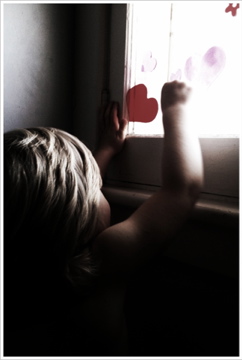
jasper hearts

You can search throughout the entire universe for
someone who is more deserving of your love and affection than you are
yourself, and that person is not to be found anywhere. You yourself, as
much as anybody in the entire universe deserve your love and affection.
— Buddha

There But For A Rocking Chair: On Love and Fear and Keeping Our Children Safe

posted by Catherine Connors | 6:46pm Thursday December 16, 2010

Before Emilia was born, I fussed endlessly about babyproofing. Never mind that it would be months before she would even enter the world, let alone move around it and find its electrical outlets: I was convinced that when it came to babies, there was no such thing as too many precautions taken too soon. So we did everything: plugged electrical outlets, purchased baby gates, secured the cords of window blinds, babyproofed cupboard doors, checked the house for mold and lead paint and random specks of dust. And we secured bookshelves to the wall. And paintings, and photographs, and pretty much anything else that could conceivably come loose and turn into an agent of harm.

Everything, that is, except the dresser in her nursery. It wasn’t that we disregarded it; it was that it was a late addition to the room, and got moved from corner to corner while I dithered about where it best served the nursery’s feng shui, and it was never in exactly the right spot, a spot that I could commit to. By the time in ended up in the place where it stayed, Emilia had arrived and I was distracted and dotting the i’s and crossing the t’s on our extensive babyproofing efforts fell to the bottom of my list of things to worry about, and the dresser just never got secured to the wall. Until it almost fell — almost, I say, because its fall was prevented by a silly little rocking chair that she had, at eleven months old, pushed in front of it in order to get to something — I forget what — on top. The dresser toppled and knocked her off the chair and was halted in its crash by that same chair and really, I can’t remember much more than that, other than the absolute, abject terror that I felt when I chased down her screams into the room and saw what had happened. I never wrote about it. The horror — and the guilt — was too acute. She might have died. She was — I was — we were — lucky.

Others have not been so lucky. Dana, and her darling little Tiggy,were not so lucky. (A warning, which applies to the preceding link, and what follows: This story is deeply distressing. Really.)
It’s a simple story, but a horrifying one: Dana’s toddler, Tiggy, was playing near an unsecured dresser, a heavy one, and it fell on him, and it killed him. It killed him. Just one moment, one piece of furniture, one small child. And death. An utterly preventable death.

That the death was preventable is what adds an extra punch to the gut here. Because that whole idea, that death can be preventable, is what torments all of us, parents especially. It’s what draws us to the idea of so-called helicopter parenting; it’s what keeps us up at night, listening for our babies’ breathing; it’s what leads us to imagine that it’s entirely possible that we’ll never want to let our children learn to drive, or date, or even leave the house alone. We’re terrified by the idea — the idea that I think most of us know so intimately that we can practically feel it, touch it, see it glimmering in the air before us — that something might happen to our children that we could have prevented, that we might, someday, face the dreaded specter of ‘if only I’d… (not left him alone in the crib, not let her go outside to play, not let him out of my sight… not left that dresser unsecured)’. This idea is our monster, our bogeyman. This idea is our enemy.

This idea is our enemy, because if it is given too much power, it can overwhelm us and not only deprive us of the ability to enjoy our parenthood, but also, at the other extreme, lure us into a false sense of safety when we feel that we’ve taken all the precautions that we can. It draws us into a kind of magical thinking, where we can spin from one belief — that anything and everything can and will harm our children — to another — that if we just follow all the rituals, conduct all the ceremonies (batten down all the hatches, check everything for toxins, secure all the furniture and set all the alarms), we can save them from all harm — and in the process cause us to lose necessary perspective, the perspective that tells us: do everything that you can, but know that you cannot control perfectly the lives and lifeworlds of your children.

This important, I think, when we consider a story like Dana’s and Tiggy’s, because it is tempting — so tempting — to just shriek out, “SECURE YOUR FURNITURE! GO, DO IT NOW! GO, DO IT, SO THAT THIS WILL NOT HAPPEN TO YOU!” And, of course, you must go and do exactly this, you must make every effort to ensure that your home is safe for your children, that is your obligation as a parent, but, but… you must also remember that in doing so, you secure no guarantees. Taking every precaution does not inoculate your children against injury or death. It does not inoculate you from making mistakes. It does not inoculate anyone from acts of God or Nature or Fate. It does not guarantee that lightning will not strike or that cancer will not emerge or that you will not look away at just the wrong moment or that even if you never, ever look away that that something might happen right before your eyes and despite your best efforts. It does not guarantee anything, anything at all.

I consider Dana’s story and I tell myself, there but for the grace of a rocking chair… I told myself that all last night as I struggled to write this. There but for the grace of a rocking chair. I could have ended up there, despite all my best efforts, but I didn’t, and it all came down to a rocking chair.
Still, I will be checking all the dressers and bookshelves and appliances and electronics today and tomorrow and the next day, and when I am not doing that I will be obsessing about ice on the roads, and flu bugs, and toxins in everything.

End of the day, all I can say is this: Hug your children, and do your very best to keep them safe. But use your strongest and brightest energies to love them and enjoy them, not to fear for them.

Previous Posts

The Road To Heaven Is Paved With Maracas
Last weekend, I went to Mass for the first time in well over a decade. To say that it was a strange and disorienting experience would be to understate things dramatically. But it was also a deeply comforting and familiar experience. I know that that doesn't seem to make a lot of sense, but in my exp

posted 9:30:01am Mar. 09, 2011 | read full post »

Dear God (On The Catholic Church And Abuse And Evil And Crises Of Faith)
This weekend, I read an article in New York Times Magazine about the crisis surrounding the Catholic Church in Ireland as new, horrible, stories emerge about sexual abuse of children and efforts by the Church to cover up those stories. It was a teensy bit upsetting. So I started to write a post abou

posted 1:34:44pm Feb. 16, 2011 | read full post »

Buy Yourself Roses For Valentine's Day
You can search throughout the entire universe for someone who is more deserving of your love and affection than you are yourself, and that person is not to be found anywhere. You yourself, as much as anybody in the entire universe deserve your love and affection. -- Buddha

posted 9:07:07am Feb. 10, 2011 | read full post »

There But For A Rocking Chair: On Love and Fear and Keeping Our Children Safe
Before Emilia was born, I fussed endlessly about babyproofing. Never mind that it would be months before she would even enter the world, let alone move around it and find its electrical outlets: I was convinced that when it came to babies, there was no such thing as too many precautions taken too so

posted 6:46:18pm Dec. 16, 2010 | read full post »

Blog The Change You Wish To See In The World
I wrote this post a few months back, when I was in Africa. It's worth reposting today, on World Aids Day, because I think that the reminder is an important one: that those of who have a voice - whether those voices are carried virtually, or otherwise - have a responsibility to use our voices for tho

posted 7:33:05pm Dec. 01, 2010 | read full post »


About Beliefnet

Our mission is to help people like you find, and walk, a spiritual path that will bring comfort, hope, clarity, strength, and happiness. More about Beliefnet.

Help

Media Kit

Subscribe

Legal

Copyright © Beliefnet, Inc. and/or its licensors. All rights reserved. Use of this site is subject to Terms of Service and to our Privacy Policy. Constructed by Beliefnet.

Advertisement

Report as Inappropriate

You are reporting this content because it violates the Terms of Service.

All reported content is logged for investigation.