The Road You're On

The Road You're On

Need some fresh air?

posted by Gayle Trotter

“Jesus said, ‘If you love me, you will do what I command.’  Some people live on the ‘Do what I command’  side of that comma, but we need to get back to the ‘If you love me’ side of that comma.  When you are in love, the relationship becomes this fresh air internal motivation.”

url.jpg

Gayle Trotter:  I’m speaking with Pastor Chris Hodges, author of Fresh Air: Trading Stale Spiritual Obligation for a Life-Altering, Energizing, Experience-it-Everyday Relationship with GodWhat do you mean by fresh air and how can we experience it?

Chris Hodges:  Everyone has already experienced this kind of culture. Fresh air is a culture where things thrive. All of us have been in either life-giving cultures or we’ve been in life-taking cultures. We’ve all been in homes where it just was empowering and life-giving and free and so you wanted to be around. Others were raised in homes where you simply couldn’t wait to get out of it. We’ve been in churches in the same way. They’re using the same songs, same Bible, but one of them is life-giving and one of them, you’re just looking forward to it being over.

It’s these life-giving fresh air kinds of cultures that make everything in our lives thrive. I base my book around a very obscure little verse out of 2 Timothy where the Apostle Paul referred to this guy named Onesiphorus who visited Paul while he was in prison. Paul said “his visits revived me like a breath of fresh air.” Paul was saying that when this guy came around, he was encouraged and free again. It was all life-giving again.

So many live in the “doldrum state,” a state where there is no wind in your sails. I wrote about applying it to all these areas of our lives so that we can have the wind back in our sails.

GT:  You talk in your book about how the year 1999 was the worst year of your life. How so?

CH:  I’m not a depressed guy. I’m outgoing. But something was missing, and I didn’t know if it was medical. I didn’t know if it was spiritual. I didn’t know what was going on. The best way to describe it is that I was just going through the motions. I was serving as an associate pastor, and I just was going through the motions. It was like where you’re on a journey but the only way you’re getting there is just to paddle really hard. You’re working really hard and nothing is energizing it.

There’s this place called the Doldrums that’s right around the equator. Because of the Northern Hemisphere, the trade winds spin one way and in the Southern Hemisphere, the trade winds spin the other way. There’s a zone right around the equator that they call the Doldrums where there is no wind. Back before there were motorized boats, when it was purely sailing by wind, if you ended up in the Doldrums, you didn’t get out. You died in the Doldrums.

I start the whole book with identifying with what I believe are thousands of people who are simply going through the motions with no wind in your sails and you’re in the doldrums. You’re putting on a smile but inside, you’re dying. I use my own experience of that so people can have the freedom to get out of it with me.

GT:  You write, “The world around us tells us that we must look good to get ahead, which often leads us to spend money we don’t have and invest time in pursuits that bring us only temporary comfort or prestige.” Can you explain?

CH:  When you end up in the doldrums, you still need to go forward so you manufacture energy. You’re padding really hard. As it relates to culture, people will put on the smile or they’ll put on some image with money and spend money that they don’t have to impress people they don’t even like. They’re trying to create something but they’re creating it the wrong way.

In the second story of the Bible, God put two trees in the garden – one, the Tree of the Knowledge of Good and Evil, and the other, the Tree of Life. He said, if you’re going to pursue life, if you’re going to pursue me, if you’re going to pursue religion based on just your knowledge, your external knowledge of things, it’ll kill you. What you need is life. What you need is something energizing all of that. And in fact, when I teach this in conferences, I often start with this message and just simply say that there’s a choice. Most of us have a tendency of making the wrong choice of just manufacturing that energy.

GT: You write about generosity. Why is generosity important in getting this feeling of fresh air?

CH: There actually are seven or eight qualities or attributes that I talk about that can get you back into a fresh air kind of a lifestyle. I have bent toward the money thing. My dad was an auditor for the State of Louisiana and I was raised up in this very strong financial culture and I see money as being one of those things where boy, it can be life-giving, one of the best parts of your life. If you get it wrong, it can be life taking. It could be one of the worst parts of your life.

One of the greatest antidotes to selfishness is generosity. I write about bringing some fresh air to our finances.

GT:  You write that, “Religion is man’s external effort to please God but God doesn’t care about all my efforts to get it right. He wants more, something far greater.” What do you think God wants from us?

CH:  In one word, God wants relationship, not religion. Jesus himself said it in Matthew 7. He said there’s going to be a lot of people who will show up in Heaven on Judgement Day who would’ve done the religious motions – calling him Lord, the miracles in His name – he lists all these religious things. Then he says I’m going to tell them plainly “Away from me because I never knew you.” The word “know” there is the same word that the Bible uses where it says, “A man knew his wife and they had a baby.” It’s an intimate term.

In John chapter 14, Jesus said, “If you love me, you will do what I command.” For years, I read that out of the Tree of the Knowledge of Good and Evil out of this non-fresh air mentality and here’s how I read it. I heard, “If you love me, you’ll prove to me you love me by doing what I told you to do. If you love me, you will do what I command.” But that’s not what it says. It says, “If you loved me, you will do what I command. All you need to do is fall in love with me and my commands are going to be the byproduct of that love relationship.” And I think there’s a comma there between those two phrases. Some people live on the “Do what I command” side of that comma but we need to get back to the “If you love me” side of that comma. When you’re in love, the relationship becomes this fresh air internal motivation. Here’s the simply way to say it. It goes from the “have to do it” to “you want to do it.” From the “got to” to the “get to.”

GT:  How do we know God without religion, though?

CH:  You don’t know God with religion. Religion is simply things man created to try to approach God. We think that God is impressed with our church attendance or our liturgies but that’s not what he’s looking for. He never came to Earth for those. He came to be in relationship. That was his whole purpose. The liturgies and all of the baptisms and communions and church attendance and giving and serving, they are all important but they are all important as a result of the relationship, not the things that create the relationship.

Let me give you an example. For instance, putting on a wedding band does not mean that I have a good relationship with my wife. Because I have a familiar with my wife, I put on a wedding band to let the world know. Too many times, we’ve thought that those motions actually get us to God and no, you have to get to God so that you can do all of those things.

GT:  It’s interesting you raised that example because now, a lot of young people are choosing not to get married and just focus on the relationship. What would you counsel those who are saying it’s just a piece of paper, it’s just a ring, it’s really all about the relationship?

CH:  All of the actions are important. Again, I’m not dismissing them. I’m just talking about the order that relationship needs to proceed the commands of God in the Bible. All of the commands, including marriage vows and getting married, all those are very important but it’s built on the foundation of relationship. If you do those things without the relationship, it’s almost certain that the relationship will fail. That’s why a lot of religious people aren’t finding a lot of success in their walk with God is because they’ve done the motions without the relationship.

I’m not saying eliminate the commands of God, I’m just saying we need to put them in the right order. When you’re in love, it just changes everything. The motivation changes where it’s something that becomes the delight of your life. I’m just so concerned for people who are trying to fulfill the bible without being in love with God. I’m telling you, Gayle, it’s almost impossible. But when you’re in love, 1 John chapter 5 says, “Now his commands are no longer burdensome because he who has the Son has life.” When you’re in that relationship, it fuels everything where it becomes the delight, not a duty.

GT:  You write also about our relationships with other people and specifically, you write, “Nothing has the potential to drain our breath and leave us feeling alone and exhausted more than other people.” You have some suggestions on how to turn those relationships into something that breathes fresh air into our lives rather than drains us.

CH:  That’s the cool part of the book is that once we unpack this principle of living a fresh air life, there are eight application chapters of let’s get this working in our family. Let’s get this working with our kids. Let’s get this working with our marriage. Let’s see if we can bring some fresh air to our Bible reading, to our worship, to prayer. Most people don’t enjoy prayer. When you approach it from a fresh air standpoint, it’s enjoyable again. Giving money, all these areas are added to your purpose in life.

There are all these applications and probably, without a doubt, one of the areas that can suck the life out of you or it can add life to you, are your relationships. There’s a chapter in there describing Cheers, that saloon where all those people gathered to be revived and refreshed by those close relationships. The theme song is, “Where everybody knows your name.” I maintain that you can be in a big church meeting or in a lot of environments with a lot of people and still be very lonely. I write about how God put in motion a plan for every person to be ultimately fulfilled and receive all that he has through powerful relationships. But they have to be shaped in a life-giving way.

The Thorny Places with Shayne Wheeler

posted by Gayle Trotter

“The only way we can go in and experience the transformative presence of Christ is to go in these difficult places assuming that we’re not coming back.”

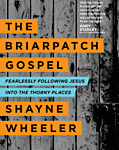
Gayle Trotter:  I’m speaking with Shayne Wheeler, author of The Briarpatch Gospel. Your subtitle is “Fearlessly following Jesus into the thorny places.” Where are the thorny places right now?

Shayne Wheeler:  They’re all around us. It’s all of those places that challenge our comfort zone, challenge some of our assumptions about what a comfortable life should be. It’s the places of dealing with people who are different from us, whether it’s socioeconomically or how they think about life and think about God. It’s people who are different from us in terms of the suffering that they’re dealing with, social issues. They’re everywhere. We have an assumption, especially as Christians, that we’re going to come to faith in Jesus, and we’re going to follow God and everything is going to be great.

We spend so much time trying to make our lives comfortable and without any bumps and bruises. We end up trying to avoid all the briarpatches of difficulty. That’s just simply not the way that life actually works, and it’s definitely not the life that Jesus has called us to.  I think he’s called us to go into those thorny places with the gospel of grace, hope and affection.

GT:  Who would most benefit from reading your book?

SW:  I wrote the book with two groups in mind — those who are dealing with difficulty in their lives, whether the reality of suffering, of persecution, and even a difficult relationship that they can’t quite get their theology around. I wanted to be able to give those people a pathway through the difficulty so that they can begin to realize that they’re not abandoned and alone but that Christ is actually walking down this path with them. But then secondly, I wrote it for people who are in relationship with people who are going through difficult times. I wanted people to have the vernacular to speak to someone who is suffering, to speak with someone who is perhaps theologically different than them or in terms of lifestyle.

We have a lot of people here in our church that have very, very close friends who are in the gay and lesbian community and many of them profess faith in Christ. I wanted to be able to give them a vernacular of how we can communicate and love and live together as followers of Christ with people with whom we disagree.

GT:  You tell the fascinating story of two brothers in the movie Gattaca. How does this relate to the briarpatch?

SW:  There’s one brother who is the older brother and is genetically inferior. The younger brother was conceived through the use of eugenics and he is genetically pure. The younger brother is stronger, faster, and smarter. They played this game called chicken where they would swim out in the ocean as far as they could and whoever turned back first lost. The genetically superior brother always won. Then finally the older brother who was supposedly inferior, he won and not only once, but he won again. And so, the other brother said “How did you beat me? How did you do this?” The older brother answered, “I swam out there and I was committed that I was never coming back. I was never going to swim back. I was committing full force into this.”

That’s the sort of mentality that we need to have when we’re entering into these difficult places with people, that we’re following Christ into some of these places where he does his best work rather than saying I’m just going to go and put my time in at the homeless shelter or at the food bank for an hour on Saturday and then I’m going to retreat back to my place of comfort and safety.

We have to say “No, I’m going to give my life to loving people who are homeless, loving people in the gay and lesbian community, loving people who are suffering.” The only way we can go in and experience the transformative presence of Christ is to go in assuming that we’re not coming back. This is a path that we’re going to walk down the rest of our lives. The degree of grace and affection and personal transformation and the palpable presence of Jesus that you experience when you do that, when you’re willing to not turn back, is extraordinary. It’s absolutely life changing. I wanted people to experience in their walk with Christ what I’ve experienced in mine and what we’ve seen happen here in our church.

GT:  How can one find meaning in the crucible of suffering?

SW:  That was probably the hardest part of the book to write for me. Our daughter was diagnosed when she was five with leukemia. I always tell people, as a parent when you imagine what it might be like to hear the words about your child having cancer, it’s ten times worse than you can imagine. I never would have imagined that Jesus could show up in the midst of suffering like we experienced him through those years of dealing with her treatment and almost dying for over two years.

I always remember lying there in her hospital room asking God where he was and asking him how could he allow something like this to happen and does he even care — really just crying out to him for answers. It was almost like the Lord spoke. I’m a Presbyterian so God doesn’t speak in audible voices to me, but I’m telling you as a Presbyterian I heard God speak very, very clearly. “Shayne, this is why Jesus had to come. This is why I had to send my son to die on a cross, to suffer for sin. It wasn’t just to get you into Heaven one day. It was because the world is all screwed up. It’s not supposed to be this way. Little five-year-old girls are not supposed to get cancer. That’s sin as well. That’s the effect of sin.”

Jesus had to come to put the world right. How we met Christ in the crucible of our own suffering was we realized that he was there with us. Suddenly his incarnation and his suffering and his death and his resurrection had meaning beyond just getting me saved. It showed my wife and me that Jesus is concerned about our daughter’s suffering so much so that he came and suffered himself. Knowing that he’s there walking with us even in those dark places in a hospital room was extraordinarily comforting to know our daughter’s suffering and our suffering was not in vain but it was under the gaze of a loving God.

GT:  Describe what makes your church community different from others.

SW:  I assume most of them are wonderful in their own right. But what I love about our church’s community is the deep sense of honesty about who we are. For our church family Sunday mornings is not the time when we get all spit shined and polished and put on our nice little self-righteous Christ veneer and come to church and try to impress everybody. Sunday morning is a time where we come as brothers and sisters in the faith, where many come who are not Christians but who are looking to find God, to figure out if God is even real. We’re coming together to worship God through Christ with all of our successes and all of our failures, with all of our hopes in faith and with all of our doubts.

When you have a group of people who take off all that veneer and they’re simply there as they are, not hiding their joy and not hiding their pain, it creates a very strong sense of raw intimacy. What it also means — people say this all the time when they come into our church — it means that no matter where people are they feel welcomed. They don’t feel judged. They see pastors and leaders and old people and young people who are dealing with the same things that they’re dealing with.

I think what might set our church apart a little bit would be that sense of you don’t have to clean up and dress up. You just have to show up.

GT:  How do we transform the Briarpatch?

SW:  Jesus said very, very clearly, “You are my disciples. Your job is to go. Your job is to not be perfect. Your job isn’t to be religious or anything like that. Your job is to go and love and serve.” They are going to know you’re my disciples he says, by the way that you love one another. He says go and serve in my name when you give food to the hungry, when you give clothing to the naked, or go visit those who are in prison. You do so in my name. What he’s saying to us is that we are the living embodiment of his gospel — the gospel of reconciliation, of grace and mercy and healing and forgiveness.

He says when you go and you serve in this way you’re actually bringing my presence into this world. We’re living as a lamppost saying this is what the transforming of presence of Christ does. We have a hope that when he returns that he’s going to make all things new. He’s going to restore his creation. He’s going to wipe out sin and our job is to be a signpost, a lamppost to what that can look like. We’re not going to do it perfectly. Our light is going to flicker and sometimes even be snuffed out, but we’re still called to go and love and serve in a way that shows that the presence of Christ is real and that something even greater is coming.

Just in practical terms, it means obviously things like you go and serve the homeless and you serve the poor. But, it also means that we go in our marriages, in our families, in our work relationships and we live lives of forgiveness and mercy. It means we don’t hold grudges. It means we show compassion to people — even the people we love the most are sometimes the hardest people to show compassion towards. It means we live lives in repentance. It’s showing the people that are closest to us and the people perhaps who are watching us, observing us from afar, showing them what a life of repentance and faith looks like — a life that’s not lived for ourselves but lived for the glory of God through Christ and lived to be poured out for the sake of other people.

When that happens, when you start infusing forgiveness and compassion and radical love into your relationships at work and at home and in your community then it will necessarily begin to bring transformation. It changes the conversation. It changes the ethos of the place.

GT:   Yes. What’s something that surprised you in writing this book?

SW:  Beyond that it was going to take three years from start to finish?  I was honestly thinking I’ll knock this thing out in like three months, write it, and then it should be on the shelves by Thanksgiving that year. That was two years ago. I was surprised at how much fun it was to write. How much I enjoyed sitting down and working through many, many, many hours of putting these thoughts and these stories onto paper. It was cathartic for my soul. It absolutely was rejuvenating and refreshing to me.

I didn’t expect to enjoy the writing part as much. I was surprised by that. And, I was surprised by how long it actually takes to go from me typing it out on my computer to it actually coming out in book form.

GT:  Was that frustrating for you knowing that you could just throw it all up on the internet?

SW:  I know. It’s unbelievable. I will give a compliment to Tyndale, our publishers. I was surprised to find people in the publishing industry who were so fantastically competent but also kind and generous and loving. Every man and woman that I worked with at Tyndale has shown more concern for me as a person and as a follower of Christ than they have for me as a commodity.  Writing a book is all worth it just for having met my friends at Tyndale.

Exceptional Gratitude

posted by Gayle Trotter

“The way that you demonstrate exceptional gratitude is you give freely, from your heart, to those who are in need.”

Tommy Newberry spoke with me about his new book, 40 Days to a Joy-Filled Life.  With Christmas fast approaching, I wanted to share with you his thoughts on exceptional gratitude.

Gayle Trotter:     What does exceptional gratitude mean to you?

Tommy Newberry:     Exceptional gratitude is gratitude beyond the norm. It is being grateful for the little things, and the big things. It is more than just gratitude as expressed verbally. Somebody hands us our food and we say thank you. Somebody holds the door for us and we say thank you very much. That is routine gratitude that most polite, mature people implement or they express that in their day-to-day lives. Exceptional gratitude is proactive gratitude, gratitude that has gone the extra mile. It is living in such a way that even if we never actually said thank you, people would realize how grateful that we were. If you are financially successful, then giving of your wealth to worthy organizations, to people in need, that shows gratitude. There is no reason for guilt, but there is reason for gratitude.

The way that you demonstrate exceptional gratitude is you give freely, from your heart, to those who are in need. If you appreciate having the freedom that we have so far in this country, then one of the ways that you show that you are grateful is that you maybe do a little bit of homework and you learn about how you can articulate these principles better. You volunteer in your community and you get involved in community activities that need your input. If you are grateful to be a parent, and you are grateful for your children, then that means that you sometimes say no to other things that would take your time away from being with your family. If you are grateful for being alive and having a healthy family then that means that you say those things to your husband or wife or to your kids or to your mom and dad. You say those things that you really mean and feel while you still have the opportunity before it is too late. So, exceptional gratitude is standard gratitude with the extra mile, doing more than the minimum as far as gratitude is concerned.

GT:     What is the thing you are most grateful for in your life?

TN:     I am most grateful for God’s grace that I do not have to earn my way into heaven. Beyond that, I am grateful for my wife, and I have three great boys that are all healthy: a sixteen year old, a fourteen year old and a six year old. They keep me focused and give me plenty of stories as I teach. I am grateful for my clients, I am grateful to be alive, I am grateful for the great plans that God has for me. That is one of the beliefs that we share with our clients, that if you do believe that God has great plans for your future, then you are going to be expressing a lot more joy than somebody who is melancholy about that. I will often ask an audience, “How many of you believe that God has great plans for your life?” Most people will raise their hand, mainly because they know that is the proper answer. Then I will say, if you believe that God has great plans for your life, then would you not walk around with enormous joy, knowing that there is a promise there that you are anticipating and waiting for? People start to get that joy is not about outward circumstances, it is about an inward frame of mind.

Can Music Set You Free?

posted by Gayle Trotter

Thanksgiving inspires us to pause and count our blessings of family and friends. Defiant Requiem, a new film showing Jewish life in the Nazi concentration camp Terezin, filled me with similar thoughts of gratitude and admiration.

Many of the inmates of Terezin were musicians and artists. Despite living in wretched conditions of hunger, disease, and forced labor, the inmates relied on their art to give them hope and foster community. They staged plays, composed operas, and created drawings with paper and ink.

An imprisoned conductor, Rafael Schacter, assembled a choir of 150 voices and taught them Verdi’s Requiem. The choir rehearsed in the basement after long days of forced labor and little food. The singers memorized the difficult music because they had no scores.

Verdi’s Requiem is a musical setting of the Roman Catholic funeral mass. You might consider this an odd choice for Jewish inmates to devote themselves to learning, but Schacter had a plan.

Part of the requiem contains the Dies Irae, which translated from Latin means “day of wrath.” In this part, the choir sings in Latin, “When the Judge takes His seat/ 
whatever is hidden will be revealed/ 
nothing shall remain unavenged.”

Schacter hoped to have his choir sing this condemnation to the Nazis, without them even knowing it.

The film runs on a dual track. As the story of Schacter and his choir is told, conductor Murry Sidlin assembles a modern-day choir to go back to Terezin and perform Verdi’s Requiem, in memorial to those who suffered at Terezin.

Mr. and Mrs. Krasa were interned at the camp, and they and their two sons accompany Sidlin back to Terezin. Mr. Krasa had been Schacter’s roommate and sang in Schacter’s choir.   He sings again, with his sons, and as a free man.

On the entranceway to Terezin, the Nazis inscribed, “Work will make you free.”

It is hard to imagine circumstances worse than those experienced by the Jewish people in World War II. After watching Defiant Requiem, I once again realized that music truly can set one’s spirit free, despite the subjugating efforts of evil men. I am grateful for that.

The Catholic Church has AIDS

posted by Gayle Trotter

Offending seemingly everyone and everything is not easy. Still, the creators of “South Park” managed that feat in their 2004 movie “Team America: World Police.”

The movie includes a scene depicting a Broadway production, “Lease,” a parody of the critically acclaimed, award-winning musical “Rent.” The parody riffs on life under the shadow of AIDS —

Well I’m gonna march on Washington

Lead the fight and charge the brigades

There’s a hero inside of all of us

I’ll make them see everyone has AIDS . . .

Everyone has AIDS!

My grandma and my dog ’ol blue (AIDS AIDS AIDS)

The pope has got it and so do you (AIDS AIDS AIDS AIDS AIDS)


And so “Lease” offers its unsubtle observation that “Rent” may have gone overboard in depicting the extent of the AIDS crisis. Critics charge that the extent of the crisis cannot be overstated and that the Catholic Church has failed to do enough.

Answering the charge that the Catholic Church is “heartless in its pursuit of principles over care of the sick and dying,” Austen Ivereigh provides Catholics with a way to find their voice in a society that increasingly criticizes the views of the Church and its adherents.

Ivereigh tackles AIDS and other issues in his book, How to Defend the Faith without Raising Your Voice: Civil Responses to Catholic Hot-Button Issues. Among other nettlesome topics, he covers the HIV/AIDS epidemic and the challenges facing Catholics worldwide.

The Church’s approach to handling the epidemic, particularly in Africa, presents intractable difficulties and generates headlines such as “Pope Tells Africa: ‘Condoms wrong.’”

The Church’s message competes with some evidence that condom usage by high-risk populations in the United States and Western Europe has successfully reduced infection rates. Yet, to critics’ dismay, the Church has continued to promote behavior change as the solution to the African AIDS epidemic, to the exclusion of condom usage.

Last month, the International HIV/AIDS conference met in DC. The Conference billed itself as the “premier gathering for those working in the field of HIV, as well as policy makers, persons living with HIV and other individuals committed to ending the pandemic.”

The conference sought to offer the opportunity to “assess where we are, evaluate recent scientific developments and lessons learnt, and collectively chart a course forward.”

With a burning desire to help hurting people at the margins of society, Catholics may take this chance to ask themselves what lessons the Church has learned about HIV/AIDS and what course forward the Church may chart.

From the earliest days of the AIDS epidemic, in the 1980’s, the Church served as a first responder to the HIV/AIDS crisis in Africa. “Catholic and Protestant churches had been running exemplary AIDS programs in Africa since the 1980’s,” Ivereigh says, quoting Helen Epstein’s The Invisible Cure.

The people make up the Church. So when the people of Africa have AIDS, Ivereigh argues, the Catholic Church itself has AIDS.

Critics blame the Church for not advocating condom use to combat the spread of AIDS. This “wrongly assumes that condoms are the key to combating AIDS in Africa,” says Ivereigh.

Instead, the Church uses a different approach by seeking to promote responsible sexual behavior, including a call to chastity and fidelity.

More important, the Church has been working tirelessly to overcome the stigma of AIDS and poverty.

Ivereigh counsels Catholics seeking to put the Church’s case in the public square to recognize the positive intention behind the criticism. Critics argue that, in the interest of saving lives, the Church “should be willing to accept condom use, even at the risk of condoning adultery, fornication, incest, and other abuses, or apparently violating Church teaching against artificial contraception.”

Underlying this critique, Ivereigh suggests, is a concern that “Christians should recognize from the Gospels.”

The way forward for the Church, according to Ivereigh, is to continue “assisting people in avoiding infection, providing tests to find out if people are infected and offering physical and spiritual care to those who are.”  The Church can continue “working in communities to combat stigmatization and discrimination; caring for those affects (especially widows and orphans) helping those infected to ‘live positively’; and advocating on behalf of persons living with HIV and AIDS.”

Through its experience, the Church has shown that programs focusing on behavioral change are more effective than those merely promoting condom usage. In Uganda in the 1990’s, HIV infection rates declined from 21% to 9.8%, mostly because of a change in sexual behavior, including a “reduction in non-regular sexual partners and an associated contraction of sexual networks” that form a superhighway for infection.

Another lesson learned: Comments from bishops and the pope can ignite firestorms of controversy. Some Church leaders had mistakenly reported that condoms are “porous” and do not protect from disease.

When the pope spoke out against condoms in 2009, critics accused him of ignorantly opposing condoms because they were porous. Instead, the pope’s comments against condoms actually followed a concern that they are an ineffective strategy.

Catholics and the Church care deeply about an effective response to HIV/AIDS. This is because they live in communities ravaged by the disease, Ivereigh points out. The Church is on the front line of the effort to help prevent infection, help those infected lead good lives, and care for those made orphans and widows by the unforgiving disease.

The Catholic Church and those Catholics on the ground in highly affected areas like Africa should not be shunned from international discussions and efforts to respond to HIV/AIDS.  Although their views are unpopular, they have decades of experience in the trenches, and they care for those left abandoned by the rest of the world.

“Learn to do right; seek justice,” the prophet Isaiah instructed the people of Israel, “Defend the oppressed. Take up the cause of the fatherless; plead the case of the widow.”  Today the pope and his bishops lead the way for Catholics to do the same.

Beauty and Prayer

posted by Gayle Trotter

“You possess a rare beauty, my love, in here,” Snow White’s mother tells her as she touches Snow White’s heart. “Never lose it.” The new film Snow White and the Huntsman captivates the audience with a dramatic retelling of the old fairy tale.  The key themes are beauty, power, and the desire to avoid growing old.

The film relies on beautiful scenery and costumes to transport the viewer to a time of medieval knights and French ambiance.  In this world, Snow White is a threat to the power hungry queen, Ravenna, who fights the ravages of time by sucking out the life of young countryside maidens.

Snow White’s strength comes not only from her physical beauty, but also her childlike purity.  She makes dolls and plays with girls much younger than she is.  She remains kind and faithful, even praying the Lord’s Prayer as she spends years locked in solitude in a dark and fetid prison cell.

Her character reminded me of St. Joan of Arc.  St. Joan was a young French girl who led forces in battle, in obedience to the voice of God.  A deep prayer life sustained Joan as she faced many challenges, including a trial for heresy.

Modern Christians also need a deep prayer life to sustain them through the trials we each face.   Monsignor Peter J. Vaghi’s fourth book in his Pillars of Faith series, The Prayer We Offer: A Catholic Guide to Communion with God, calls us each to a deeper understanding of prayer.

“Christian life, “ Vaghi explains, “is marked by much outward activity and a corresponding need for regular inner retreat.”  Even Jesus had a hard time escaping his followers to find a quite place to reconnect with his father in prayer.

To imitate Christ in his dialogue with his father, we employ the prayer known as the Our Father or the Lord’s Prayer.  Vaghi explains how this prayer is “the fundamental Christian prayer,” and he encourages us to make it central to our prayer lives.

While most of us will not have to face a supernaturally powerful and evil queen aiming to suck the very life out of us, most of us face problems that seem as dark and inescapable.

When we remember that prayer can give us supernatural strength for the journey, we will have a rare beauty, in our hearts, that can never be lost.

A Fine on Faith?

posted by Gayle Trotter

Tomorrow at noon, in cities all across the U.S., people will be gathering in support of religious freedom.  These Stand Up for Religious Freedom Rallies follow the successful March rallies held in 145 cities across the nation, drawing 63,000 people.

The rallies respond to the Health and Human Services federal mandate that requires almost all employers to provide through their health plans controversial medical procedures and drugs or pay heavy fines.

Despite knowing that the provision of these items violates the faith of millions of Americans, the Administration has refused to rescind the mandate.

While the Supreme Court debates the merits of Obama’s signature health care law, Americans are not merely waiting to see the results.

Instead, they are reaching out to their communities and lawmakers to help them understand how a threat to one citizen’s religious faith is a threat to all of our freedoms, and not just religious freedom.

For the citizens of a country founded on the principle of inalienable rights, these rallies are a great opportunity to remind our lawmakers that there should be no fine on faith.

Ten Commandments: You decide

posted by Gayle Trotter

Watching the HBO Sopranos series recently, I was captivated by the story of a mobster, Tony Soprano, who does horrible things to make a living and yet has to deal with the typical problems every father, son, husband, and brother have to face.

The three episodes I have watched could be entitled “The Commandments We Do Not Keep: A Guide to Living an Immoral Life.”

Some of the mobsters do not seem to have any pangs of guilt about their transgressions, but Tony Soprano’s visits to a therapist give evidence that Tony does experience guilt about his egregious violations of the Ten Commandments.

In The Commandments We Keep: A Catholic Guide to Living a Moral Life, the third book in his Pillars of Faith series, Monsignor Peter Vaghi holds up the Ten Commandments for our generation.

“Living the faith is about free choices,” Vaghi suggests, “at home with our families, in the workplace, at places of recreation, and during the time we spend alone.”

Although following the Ten Commandments is essential, Vaghi recognizes that “the moral life is about life in Christ Jesus, about following him and living in him.”

At the end of the book, Vaghi appends a guide to confession and an examination of conscience.  These “exam” questions are designed to help us confront our sins, be forgiven, and not repeat them.

Tony Soprano first seeks out a therapist when his actions cause him to have panic attacks, and he experiences a loss of consciousness.  Sin has a corrosive effect on our souls and our bodies.  Without a way to confront our sins, the sins just multiply.

We do not need to lead the life of Tony Soprano to reap the benefits of reforming our actions.  When we strive to keep his commandments, God’s love is perfected in us.

For Spiritual Power, Eat Lion Meat

posted by Gayle Trotter

“I was introduced to dog meat,” President Obama recalls in his memoir, Dreams from My Father, recounting his experiences as a young child in Indonesia under the tutelage of his Islamic stepfather, whose “knowledge of the world seemed inexhaustible.”

Obama’s stepfather fed the boy dog meat and other delicacies (snake, grasshopper) and promised to “bring home a piece of tiger meat for us to share,” explaining that “a man took on the powers of whatever he ate.”

As the saying goes, you are what you eat.

“He who eats my flesh and drinks my blood abides in me, and I in him,” Christ says in John’s Gospel. “He who eats me will live because of me.” Hence, the Catholic Church teaches that the Eucharist brings “an intimate union with Christ Jesus.”

In the Eucharist, the substance of the bread and wine becomes Christ’s body and blood. Monsignor Peter Vaghi explains this doctrine of “transubstantiation” in The Sacraments We Celebrate: A Catholic Guide to the Seven Mysteries of Faith, the second book in his series on the Catholic faith.

“It is always good to spend some time meditating and focusing on what happens in the Eucharist,” Vaghi says. “It is, after all, the principal mystery of our Faith.”

For Catholics, when they consume the Blessed Sacrament, they are truly eating Jesus’ flesh and drinking his blood. Not symbolically, but really. How? “It takes faith to recognize Jesus in the breaking of the bread,” Vaghi explains.

That’s not so hard to swallow when you think about the fact that it takes another sort of faith to believe in (say) quarks, dark matter, or subatomic particles. Reality is so much more than what our five senses can perceive.

Catholics believe that they take on the power of Christ, in a real sense, through the Eucharist. Christ promised that those who eat his flesh and drink his blood will have eternal life (John 6:54).

For many of Christ’s disciples, this teaching was too hard to accept. “How can he give us his flesh to eat?” they asked. Many of his disciples broke away from that time on, John’s Gospel tells us.

Granted, the outward appearance of the elements remains the same as before the consecration by the priest. Yet, with the eyes of faith, Catholics can see that in eating the Eucharist, we become like Christ, and we remain in him and Christ in us.

Rather than eating tiger meat to gain power, we should consume the Lion of Judah. Through our faith in this mystery, we gain an intimate union with Christ Jesus.

Professing the Faith

posted by Gayle Trotter

At the Easter Vigil this year, the Catholic Church received me into full communion.  Along the road to this night, Monsignor Peter Vaghi, pastor of the Church of the Little Flower, met with me over many months to teach me the Catholic faith.  As a resource, we read four books he wrote about the pillars of the Catholic Faith.

We began our discussion with The Faith We Profess: A Catholic Guide to the Apostles’ Creed.  Pope Benedict referred to the Apostle’s Creed as the “summary of everything we believe.”

The Apostles’ Creed has twelve articles (like the twelve disciples) and is broken into three sections on the Father, the Son, and the Holy Spirit.

Studying the Creed can be intellectual and spiritual.  “Religious by nature,” we humans are “created to transcend ourselves.”  The Apostles’ Creed gives us a view of the transcendent that we seek.

At the Easter Vigil, one particular song, based on the “litany of saints,” moved me the most.  The singer invokes the heroes of the faith, name by name, asking for their assistance and prayer.

The Apostles’ Creed affirms the belief in the communion of saints as a vital part of the Christian faith. G. K. Chesterton referred to this as the “democracy of the dead” which reflects the continuous witness to the truth through history.

To read the Apostles’ Creed is to understand better the faith Catholics profess.  Using the Creed as a mirror, “look at yourself” St. Augustine suggested, “to see if you believe everything you say you believe.” Such reflections on the Creed might lead you in unexpected directions, as it did for me.

Previous Posts

Need some fresh air?
"Jesus said, 'If you love me, you will do what I command.'  Some people live on the 'Do what I command'  side of that comma, but we need to get back to the 'If you love me' side of that comma.  When you are in love, the relationship becomes this fresh air internal motivation." Gayle Trotte

posted 12:44:57am May. 15, 2013 | read full post »

The Thorny Places with Shayne Wheeler
"The only way we can go in and experience the transformative presence of Christ is to go in these difficult places assuming that we’re not coming back." Gayle Trotter:  I’m speaking with Shayne Wheeler, author of The Briarpatch Gospel. Your subtitle is “Fearlessly following Jesus into

posted 2:11:44am Feb. 18, 2013 | read full post »

Exceptional Gratitude
"The way that you demonstrate exceptional gratitude is you give freely, from your heart, to those who are in need." Tommy Newberry spoke with me about his new book, 40 Days to a Joy-Filled Life.  With Christmas fast approaching, I wanted to share with you his thoughts on exceptional gratitude.

posted 4:55:32pm Dec. 22, 2012 | read full post »

Can Music Set You Free?
Thanksgiving inspires us to pause and count our blessings of family and friends. Defiant Requiem, a new film showing Jewish life in the Nazi concentration camp Terezin, filled me with similar thoughts of gratitude and admiration. Many of the inmates of Terezin were musicians and artists. Despite

posted 7:03:36pm Nov. 26, 2012 | read full post »

The Catholic Church has AIDS
Offending seemingly everyone and everything is not easy. Still, the creators of “South Park” managed that feat in their 2004 movie “Team America: World Police.” The movie includes a scene depicting a Broadway production, “Lease,” a parody of the critically acclaimed, award-winning mus

posted 1:32:18am Sep. 13, 2012 | read full post »


Report as Inappropriate

You are reporting this content because it violates the Terms of Service.

All reported content is logged for investigation.