
The New Christians

Is the Trinity Optional?

Wednesday January 7, 2009

Categories: Theology
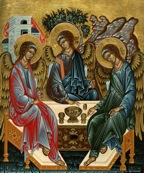
RublevTrinity.jpgOver the holidays, my mother was attempting to explain Mormonism to a 14-year-old boy who lives with her and my dad.  He's got a Mormon friend and he was wondering about that faith, especially because he's in confirmation class this year and learning more about Christianity.

My mom looked at me and asked, "Are Mormons Christian?"  It's interesting that she didn't ask if, in my opinion, Mormons are Christian, but more as a matter-of-fact.  This, of course, opens that millennia-old can o' worms: Who gets to say who is and who is not "Christian"?  (More on that in another post.)

My immediate response was, "They do consider themselves part of Christianity, but they're not.  They don't believe in the Trinity."

In fact, that wasn't quite right.  The Church of Latter Day Saints does believe in a trinity, per se, but not the orthodox Christian Trinity as articulated at the Council of Nicaea (325).  Mormons understand the Godhead to be three distinct divine beings who eternally relate to one another.  At Nicaea and after, the orthodox belief has been that God is three persons (hypostases) but one substance (homoousias).  I, myself, tend toward the social trinitarianism articulated by theologians such as Jürgen Moltmann and Miroslav Volf.  While Moltmann has ocassionally been accused of tri-theism, that charge doesn't stick based on a thorough reading of his work.

But that's less my query than the importance of the Trinity for a claim of Christianity.  I'm sure that many of my conservative Christian readers won't even have to consider this question, and neither will the liberals.  I'm more interested in those of you who are moderates.  Put the LDSers aside for the moment.  How about Unitarians?  They do trace their origins to Protestantism, and many consider themselves Christian, though others do not.  Indeed, some Unitarians (a minority, to be sure) have a traditional (or "high") Christology.

So my question is basically this: Is an orthodox Christology enough to be considered Christian, or must one also articulate a Nicaean Trinitarianism?
Advertisement
Comments
Steve D.
January 9, 2009 7:14 PM

I certainly HOPE that one doesn't have to believe Nicaean Trinitarianism to be considered Christian. Otherwise, NO ONE could be considered Christian.

The bottom-line is this: people may say they do, but no one actually believes the Trinity as articulated at Nicaea.

To believe something, one must first think it; if something cannot exist in the mind, it is incapable of being believed. The Nicaean Trinity is (in a completely non-colloquial way, but still with the voice of Vizzini from the Princess Bride) "inconceivable."

Suppose someone asked you to believe that they knew someone that knew someone that discovered a "four-sided triangle." Then after they saw the dumbfounded look on your face, they asked you to just believe the mystery.

You can't believe in the existence of a "four-sided triangle," because you can't conceptualize what it would mean for a triangle, any triangle, to have four sides.

A human being is not capable of conceptualizing one being as three persons. You can memorize the words, and even confess them every Sunday, but you can't believe them, for you can't even know what they mean.

Your Name
January 10, 2009 8:32 AM

On one Trinity Sunday my then Pastor described the trinity like her relationships. She is a Mother, a daughter, and a Grandmother. She was a wonderful pastor, but her description was condemned as a heresy by the Church (Sabellianism).

The best simple explanation I heard was God is One "What" and Three "Whos" (One essence manifest in three persons).

If most Christians (laity and clergy) can't explain it correctly, then it cannot be criteria for inclusion.

The earliest Christians prayed and sang songs to Jesus. As one pagan historian noted, "They rise before sunrise and sing hymns to Jesus as unto a god". How one squares this with the commandment, "To worship God alone" is important but not a test for inclusion.

Steve D.
January 10, 2009 9:46 AM

Your Name, I've heard the whole "one what and three whos" thing before, and I must confess that it is a great modern articulation of the Nicaean Trinity. But it is far from an explanation!

Words are simply symbolic representations of ideas.

Every idea doesn't NEED to have a symbolic representation, but every communicable idea does. Ideas without symbolic representations are expressed in everyday speech as "I can't really put it into words."

Most ideas have more than one symbolic representation. That's why we can translate the Bible into different languages. An English Bible and a Spanish Bible may have different symbolic representations, but (hopefully) the ideas are approximately the same.

Conversely, there exist many symbolic "representations" that actually represent no idea. Using a random sentence generator that I found on the Web, I generated these five sentences:

The tall breakdown precedes a judge.
A ditch boosts the contest into the recursive earth.
The venture mails a virtue over the demolished magic.
Past the traveled wound reacts the aerial rose.
An unworkable vowel turns.

These sentences can't be believed, since they can't be thought (i.e. conceived in the mind). They're pure nonsense, in the most literal sense of the word.

Such is the Nicaean Trinity: pure nonsense.

One can conceive of other Trinities, like Sabellianism and tri-theism (neither of which, in my opinion, are compatible with Holy Writ). But the orthodox doctrine is utterly nonsensical.

It is literally unbelievable, because it is literally inconceivable.

Maureen
January 11, 2009 6:39 PM

If someone says they are Christian, whose right is it to say they are not--by whose criteria? What would Christ say? I'm pretty sure he wouldn't exclude ANYONE who worshipped Him, confessed His divinity, believed in His eternal atonement, and--most importantly--behaved as he taught and treated others as He would.

len hjalmarson
January 14, 2009 7:54 PM
http://www.nextreformation.com

I just don't know if its the right question. But the one I would substitute is this: is it possible to articulate an enduring missional theology apart from the Trinity? And the answer to that I believe it "no."

Read All Comments

Post a Comment

By submitting these comments, I agree to the beliefnet.com terms of service, rules of conduct and privacy policy (the "agreements"). I understand and agree that any content I post is licensed to beliefnet.com and may be used by beliefnet.com in accordance with the agreements.


Please type the text you see in the box below to verify your post and help us prevent spam. You have a limited time to type - you may wish to compose your comment in a separate document and paste it here upon completion.

Type the characters you see in the picture above.

Advertisement

Search This Blog

About The New Christians

Tony Jones is the author of many books, including The New Christians: Dispatches from the Emergent Frontier and The Sacred Way: Spiritual Practices for Everyday Life. He is a leader in the emergent church movement and a renowned expert on postmodern theology and the American church landscape.


Find out more about Tony, his books, and his speaking schedule at his website.

feed icon Subscribe

RSS Feed

Receive updates from The New Christians
Tony on Twitter:
My Amazon Favorites:


Social Networks:
Facebook
LinkedIn
Flickr
YouTube
Vimeo
Pandora

Calendar

Advertisement

Advertisement


About Beliefnet

Our mission is to help people like you find, and walk, a spiritual path that will bring comfort, hope, clarity, strength, and happiness. More about Beliefnet.

Legal

Copyright © Beliefnet, Inc. and/or its licensors. All rights reserved. Use of this site is subject to Terms of Service and to our Privacy Policy. Constructed by Beliefnet.

Advertisement

Report as Inappropriate

You are reporting this content because it violates the Terms of Service.

All reported content is logged for investigation.
