Let me start with some throat-clearing. At least one friend and not a few commenters were bothered by the fact that I wrote about my own intuition before I started reflection on the biblical passages at play. One friend told me that, as a self-proclaimed Protestant, I should begin with the Bible, where Protestants always begin.
Firstly, don't read too much into my decision to write about my intuition first. It has something to do with the fact that I was pressed for time on Monday. Further, I was trying to be a bit autobiographical, in both the introduction and intuition posts. This blog is not particularly a place for forensic arguments, like, say, my dissertation will be. Instead, it's a place for more personal, impassioned writing.
Secondly, and I've been very clear on this point here and elsewhere, I do not think it possible to "begin with the Bible." We always begin with our own hermeneutical assumptions. Always. No exceptions. A human being cannot escape her/his own hermeneutical horizon. You are encased in it, just as you are encased in your own skin. There's no escape.
Does this mean that I reject the Lutheran formula of sola scriptura? Well, insofar as sola scriptura is naive to everyone's interpretive biases, yes. I don't think I can actually rely on scripture alone. I am always also reliant upon my own reason to interpret and apply scriptural truth (this just in, Tony Jones believes in scriptural truth!). (Just a side question here: Doesn't sola mean "alone"? As in, all-by-itself-with-nothing-else? How, then, can there be five solas? Is that not logically incoherent?)
So, I might approach the Bible differently than you do. So be it.
Now, on to Genesis!
Let's begin by looking at what the text really says:
Read Genesis 3:1-24
Now, it probably won't surprise many for me to confess that I don't think the creation of the cosmos really happened in quite the way it is described in either this creation narrative, or the one preceding it in Genesis 1:1 - 2:3. But my belief that the cosmos is 12-16 billion years old does not mean that I don't consider the Genesis account true. Quite to the contrary, I do consider it true. (Truth and factuality are not the same.) So, let's deal with it's truth.
Adam and Eve are forbidden to eat the fruit of the Tree of Life by God, and bidden to eat it by the serpent. Eve listens to the latter and passes the fruit to her partner. He partakes as well. God discovers their disobedience, and they must pay the consequences.
First, let us note that there are a couple catching phrases in the narrative. One is that the serpent tells Eve that fruit will allow her to know "good and evil," and Eve decides to eat the fruit, in part, because it was "desirable for gaining wisdom."
"Then the eyes of both of them were opened," they became ashames of their nakedness, sewed themselves fig-leaf garments, and thus there choise was discovered by God.
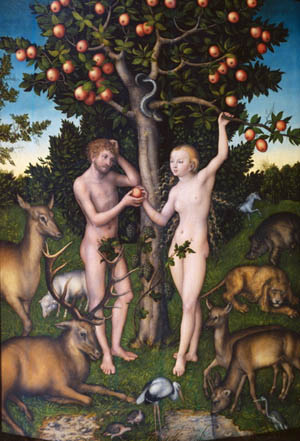
There are all sorts of interesting interpretive points to be made, but since we're focusing on the doctrine of Original Sin, let's focus on the consequences of their actions. Because of their fruity indulgence, A&E become aware and ashamed of their nakedness. And God, in turn, lays the smack down on them: the woman will have pain in childbirth and be subservient to the man; the man will toil to bring food from the earth; they are cast out of the garden; and they will both die.
In the biblical account, this is surely the orginal sin. And I think it's clear that it is meant to be paradigmatic of the human condition. Given the choice, the passage seems to teach, each of us would choose the fruit that opens our eyes rather than trusting God who tells us we don't need our eyes opened.
But is this Original Sin? That is, is there anything in the passage that says that A&E might have not chosen to eat the fruit? Or, more to the point of the Western theological notion of Original Sin, that the consequences of their sin has been passed down to every subsequent human via the act of intercourse (thus exempting only Jesus if Nazareth from this inheritence)? Is there something in the passage that would lead us to believe that, as we learned yesterday, this is an "inherited spiritual disease or defect in human nature"?
Based on 1) My own hermeneutical position that this story is truthful in that it is paradigmatic as opposed to factual, and 2) Nothing in the biblical narrative indicates that A&E were changed at the genetic level that would infect subsequent generations, I'll conclude this: The account of the original sin in Genesis 3 teaches us a lot about the state of human nature, our freedom to know right from wrong, and our proclivity to not necessarily trust God. But it does not teach that the sin of Adam and Eve is responsible for the sins of subsequent generations.
Your thoughts?
Read Genesis 3:1-24
Now, it probably won't surprise many for me to confess that I don't think the creation of the cosmos really happened in quite the way it is described in either this creation narrative, or the one preceding it in Genesis 1:1 - 2:3. But my belief that the cosmos is 12-16 billion years old does not mean that I don't consider the Genesis account true. Quite to the contrary, I do consider it true. (Truth and factuality are not the same.) So, let's deal with it's truth.
Adam and Eve are forbidden to eat the fruit of the Tree of Life by God, and bidden to eat it by the serpent. Eve listens to the latter and passes the fruit to her partner. He partakes as well. God discovers their disobedience, and they must pay the consequences.
First, let us note that there are a couple catching phrases in the narrative. One is that the serpent tells Eve that fruit will allow her to know "good and evil," and Eve decides to eat the fruit, in part, because it was "desirable for gaining wisdom."
"Then the eyes of both of them were opened," they became ashames of their nakedness, sewed themselves fig-leaf garments, and thus there choise was discovered by God.
There are all sorts of interesting interpretive points to be made, but since we're focusing on the doctrine of Original Sin, let's focus on the consequences of their actions. Because of their fruity indulgence, A&E become aware and ashamed of their nakedness. And God, in turn, lays the smack down on them: the woman will have pain in childbirth and be subservient to the man; the man will toil to bring food from the earth; they are cast out of the garden; and they will both die.In the biblical account, this is surely the orginal sin. And I think it's clear that it is meant to be paradigmatic of the human condition. Given the choice, the passage seems to teach, each of us would choose the fruit that opens our eyes rather than trusting God who tells us we don't need our eyes opened.
But is this Original Sin? That is, is there anything in the passage that says that A&E might have not chosen to eat the fruit? Or, more to the point of the Western theological notion of Original Sin, that the consequences of their sin has been passed down to every subsequent human via the act of intercourse (thus exempting only Jesus if Nazareth from this inheritence)? Is there something in the passage that would lead us to believe that, as we learned yesterday, this is an "inherited spiritual disease or defect in human nature"?
Based on 1) My own hermeneutical position that this story is truthful in that it is paradigmatic as opposed to factual, and 2) Nothing in the biblical narrative indicates that A&E were changed at the genetic level that would infect subsequent generations, I'll conclude this: The account of the original sin in Genesis 3 teaches us a lot about the state of human nature, our freedom to know right from wrong, and our proclivity to not necessarily trust God. But it does not teach that the sin of Adam and Eve is responsible for the sins of subsequent generations.
Your thoughts?

Add to Newsvine
Add to StumbleUpon
@Scott M
Thanks for your explanation. I guess it would be better if we listed all the beliefs of "original sin" and what Scripture said (if anything) about each of them.
@Chad
You meant Rom. 5:18.
Most likely nobody is still reading this thread. However, on the off-chance someone is, I wanted to share the following document. It explores the patristic distinctions between the ideas of ancestral and original sin and how that plays out in pastoral care.
Particularly germane to this thread, though, is an exploration of the story of Adam and Eve. The patristic understanding was not that man was created in some sort of perfect state from which he fell. (When you think about it, that doesn't even make sense. If man had been 'perfect' how could he have fallen?) Rather they were created with the potential for either mortality or immortality, to embrace their vocation or to turn from it.
Anyway, it's a good essay and well worth the time to read if you are interested in this subject.
http://www.antiochian.org/assets/asset_manager/da42e6049df1d08bff1865c1ac19e759.pdf
Chris, let me just say that it is surprising that they have allowed this many of your posts to clear. I have found that when you post things on here that bring Tony's "logic" into question that they often disappear.
Secondly allow me to say keep up the good work. These guys are so caught up in worshipping themselves that their Bible study is done solely to build themselves up. Their piety is disgusting and it is good to see someone show it to them. I pray that Tony's goats (er, congregation) read these posts and break free from the brainwash that he has washed them in.
This is all about them. Chris, you attempted to discuss Jesus' views and they made it about you. They attempt to discuss Jesus and they make it about them. IDOLS everywhere but be careful not to allow them to make you into one as well. We dwell with the money-changers, Pharisees, and pagans on this blog. Tony, I find it more than revealing that of Chris' points, you found it more important to tell us what you believe Jesus said and not to defend yourself from being known as a post-modern liberal and pelegian. At least you know what you are. I shake the dust from my feet Tony.
but isn't adam and eve's sin (ie. original sin) borne out in the actions of their children, chiefly Cain? and then, isn't Cain's sin passed on eventually to Lamech... and all who died in the flood (save Noah..)... doesn't Jacob inherit Isaac's sin?
"your name" i have to say that i find it telling that you're more concerned with labeling someone a post-modern liberal pelegian [sic] than you are with listening to what they believe about Jesus and addressing that.
our salvation comes from our belief in Jesus. our faith is rooted in the teachings of Jesus.
if my understanding of the teachings of Jesus result in my becoming a post-modern liberal, who on this earth can tell me that i am wrong? and yet inevitably someone involved in a discussion of theology will start quoting Luther or Calvin or Augustine (or whomever) as the perfect, definitive interpreter of Genesis, or Paul or whatever else and so insist one cannot be a Christian and be either post-modern or liberal. you complain loudly about the idolatry of the self that Tony supposedly displays and yet those who insist that all questions of theology have long since been definitively answered are themselves caught up in the idol worship of these long dead theologians of a bygone era. Luther was not perfect. Calvin was far from perfect. no theologian is perfect. if you want to avoid idol worship you -must- be willing to consider the possibility that -they got it wrong-. there is a -reason- that we do not include any of these later texts in our canon. they are not inspired, they are not perfect, they are not inerrant. if you are unwilling to consider that possibility, then you are the one worshiping idols, not Tony, nor any other post-modern liberal. post-modernism, at its core, is deeply concerned with destroying the idolatry of the self. it is all about the realization that our own intelligence, wisdom and insight is completely trapped inside our limited, personal, isolated point of view. we cannot escape from the confines of our five senses or the walls of our cultural context. enlightenment and modernity were all about the worship of the individual and the rationality of man. we are fleeing from the horrors wrought by that thinking with all speed back to a place of questioning humility. Luther had the hubris to stand up to a thousand years of church tradition and say "i think we've gotten a bit off track here, people". at the time he was treated as a heretic and an outcast. today, many risk making him into a god. how can we laud Luther's efforts against the church of his day as right and just and condemn those who raise the same objection today as being idolatrous self-aggrandizers? can you honestly look at the past 500 years of church history and see no reason why it might not be long past time to be double certain sure that we really have it right? there's an awful lot of fruit growing out there in the world with our name on it that doesn't look, smell or taste like love, joy, peace, patience, kindness, goodness, faithfulness, gentleness or self-control. you are the one who turned your entire response into being about Tony, instead of being about Genesis and the topic at hand. hating an idol can be just as much of a form of worship to it as loving it.
why not forget about Tony and engage the question? is it really so threatening to you to consider the possibility that this idea of inherited sin is flawed that you have to resort to ad hominem, slander and insult? is our faith about painting the whole world out to be evil, with -us- as the witness to it as its only salvation? or is our faith about how Jesus taught us to live humbly, with charity in our hearts for all, so that through our faith in him, the good in the world might increase?
Post a Comment
By submitting these comments, I agree to the beliefnet.com terms of service, rules of conduct and privacy policy (the "agreements"). I understand and agree that any content I post is licensed to beliefnet.com and may be used by beliefnet.com in accordance with the agreements.