
Windows and Doors

Windows and Doors

R. Crumb’s Genesis, Heavenly or Heretical?

posted by Brad Hirschfield | 10:45am Tuesday September 8, 2009

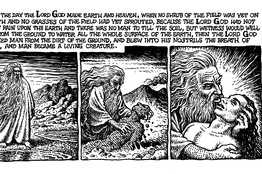
Due out next month, world renowned cartoonist R. Crumb, will share his take on the first book of the Bible. That Crumb, who gave us the famously X-rated Fritz the Cat, now applies his talents to Genesis is cause for everything from alarm to joy.
For some, the very idea that the Bible is offered up as a cartoon demeans the text and its sanctity. But to me, cartoons are simply one more way to depict the most powerful stories in the world. And if Da Vinci’s Sistine Chapel does not offend, then neither should Crumb’s Genesis. But that’s a big “if” for some people. Forget what Crumb does with the story, how do we feel about portraying God, once again as a old man with a long beard?
rcrumb.jpg
Certainly from a Jewish perspective, it violates the second of the Ten Commandments. And it won’t go down well with traditional Muslims either. But for Christians, it’s no big deal.


Once one believes that God could take on a human form in real life, it’s not so offensive to portray him as a human more advanced in years. And as many deeply believing Christian friends have told me, that God would do such a thing for us, is a sign of his incredible love for us. I happen not to share their belief, but the idea that God would take on a human form is neither crazy nor foreign to Jewish tradition either.
The Hebrew Bible is filled with examples of a largely, if not fully, humanized God. Adam and Eve hear God’s footsteps in the Garden of Eden (Gen. 3:8), Abraham receives three visitors in human form and one of them seems to be God (Gen. 18:16-22), etc. So before we go getting all high and mighty about the nuttiness of what more than a billion Christians believe, or how offensive Crumb’s work is, let’s all admit that the desire to better understand and relate to God often pulls us in this direction.
The really interesting thing about Crumb’s Genesis is how many people who may know nothing about the Bible will now give at least it’s first stories a careful read. That, for me at least, trumps everything. One of the greatest things about the Bible is that can mean so many things to so many people. And while that will probably offends fundamentalist and strict constructionists of all faiths, that very elasticity is evidence of the Bible’s sacredness.
For me, the Bible is an infinite gift from an infinite God, so how could there be only one way to read it? What is the Bible for you?


Previous Posts

Apple's "Jew or Not Jew" App -- Should It Be Legal?
An Apple application that let users guess which French politicians or celebrities are Jewish was pulled from France's App Store. but its American equivalent is still available. French activist groups said the "Jew or Not Jew?" app violated bans on compiling information on people's religion and rev

posted 1:18:48am Sep. 18, 2011 | read full post »

Is God A Christian?
R. Kirby Godsey’s new book, Is God A Christian?, challenges what the author describes as the commonly held belief among many religious people that the God in whom they believe is “one of them”.  People, Mr. Kirby observes, too often confuse God’s religious identity with their own, leading t

posted 11:59:56am Sep. 12, 2011 | read full post »

Remembering 9/11 - Part One
The tenth anniversary of 9/11 brings up many emotions and presents some very real challenges, among them how to remember the past without being imprisoned by it.  This video, filmed at St. Paul's, the church closest to the World Trade Center site, is a wonderful example of rising to that challen

posted 2:40:58pm Sep. 08, 2011 | read full post »

Gilad Shalit, Still A Prisoner After 1,900 Days
Below is a copy of the Statement I got from the White House, and while I appreciate the words, I can't help but also ask, "Is this the best we can do?"  United States Mission to the United Nations Office of Press and Public Diplomacy 799 United Nations Plaza New York, NY 10017 (212) 41

posted 9:04:17am Sep. 08, 2011 | read full post »

Is Realty TV Really Kosher? The Ethics Of Realty TV
I know, at first it seems that ethics and reality TV are about as connected as fire and water – one being the antidote for the other.  But perhaps it’s not as simple as that, a conclusion supported by the recent spate of articles arguing that reality TV producers need to create, and commit, to

posted 6:34:55pm Sep. 07, 2011 | read full post »

Advertisement
Comments read comments(7)
post a comment
Jordan Hirsch

posted September 8, 2009 at 6:50 pm


I thought Ralph Bakshi gave us “Fritz the Cat.”


report abuse
 

seymour

posted September 9, 2009 at 1:19 pm


l. at least it’s first stories a careful read.
it SHOULD read its (no apostrophe)
2. Rabbi Brad: I’d like to bring the following business article to your attention. The havoc wrought on people’s lives by the Wall Street greedheads’ shenanigans of excess (as described below) constitutes a moral problem which I think is worthy of your learned consideration.
A Year After Lehman, Wall Street’s Acting Like Wall Street Again
__
By Allan Sloan
Tuesday, September 8, 2009
It’s been 12 months since Lehman Brothers failed, setting off a chain reaction that came horrifyingly close to destroying the world’s financial system. That anniversary makes this a convenient time to take a deep breath, look back at l’affaire Lehman and see what we can learn from the past turbulent year. How has Wall Street changed since Lehman went broke last Sept. 15? What are the lessons? And what does it all mean to those of us who aren’t directly involved?
Even though some once-iconic names have vanished and others are shadows of their former selves, Wall Street hasn’t changed all that much. It still operates on the principle of taking care of itself first, really big and important customers second, everyone else last.
Among the healthy firms — which are poaching talent right and left from the dead and weak — fat profits, swagger and the delicious prospect of juicy bonuses (regulators’ income-limitation attempts notwithstanding) are back in style. Business is good and likely to get better because of the huge demand for capital-raising services in a world that’s suffered trillions of dollars in losses over the past two years. This makes Wall Street’s prospects far brighter than those of ordinary people trying to cope with losses in their stock portfolios and home-equity value. Not to mention job losses.
Now, let’s talk about what we’ve learned. First, the fact that regulators and central bankers couldn’t keep Lehman alive — honchos like former Treasury Secretary Hank Paulson say that, and I’ll take them at their word — shows us that the world’s capital markets have become increasingly powerful relative to central banks. So much for the idea of central bankers ruling the roost.
The second lesson involves what I call the secret-handshake factor. After having the world come close to melting down because of Lehman’s collapse, governments are more determined than ever to protect the surviving multinational financial giants (which happens to help us). It’s like being part of a secret club: No matter what they say to one another in public, giant institutions and their governments both know that the institutions will be treated with loving care. In the United States, for instance, various arms of the government have lavished enormous subsidies on financial institutions to keep them — and the financial system — afloat by guaranteeing their debts, giving them access to ultra-cheap capital and helping restart markets that are extremely lucrative for Wall Street. No intelligent politician or regulator wants to risk Lehman II by letting another giant firm fail.
Why Not Lehman?
The Lehman collapse came as something of a surprise because Lehman was so much bigger than Bear Stearns, which the Federal Reserve and the Treasury had bailed out six months earlier, lest its failure lead to a worldwide meltdown. The Fed and Treasury brokered a sale to J.P. Morgan Chase that rescued Bear creditors, got stockholders $10 a share for shares that were essentially worthless and stuck taxpayers with the risk on $29 billion of Bear assets that Morgan considered too risky.
Why did the government bail out the smaller Bear in the name of saving the world financial system but let Lehman fail six months later? “The U.S. government didn’t let Lehman fail; it didn’t have the authority to save it,” Treasury Secretary Tim Geithner said in an interview with Fortune. Geithner, then head of the New York Federal Reserve Bank, played a key role in the Bear and Lehman deals, getting his current job in early 2009.
“People think that the government chose to let Lehman fail because they wanted to teach people a lesson,” Geithner said, but they’re wrong. “The fundamental constraint was that the Treasury at that point had no authority” to put capital into Lehman, and “the central bank did not have the ability to fill a capital hole.”
The idea of the Treasury and the Fed being constrained feels odd, given how inventive they were at creating ways to let investment banks access some of the Fed’s bank-only lending programs shortly after Bear failed, and how they quickly invented a dozen new programs to pump money into the financial system.
But Geithner said there was a full-scale run — as in bank run — underway at Lehman. Because there was no buyer willing to assume most of Lehman’s obligations, as Morgan did for Bear, the Fed would have been risking unlimited losses because Lehman didn’t have enough collateral to back the 12- or 13-digit loans — hundreds of billions or trillions of dollars — it would have taken to meet the run. In essence, then, the financial markets overwhelmed the Fed’s resources.
Slim and None
Geithner says regulators and governments expected bad things from the Lehman collapse, but things proved even worse than they feared. Among the nasty surprises was that the Reserve Primary Fund, stuck with Lehman paper, became the first big money-market mutual fund to “break the buck.” That scared millions of average people and prompted the government to guarantee money-fund accounts to avoid a deposit run that could have destroyed short-term financial markets. There was also the beginning of potentially catastrophic runs at Goldman Sachs and Morgan Stanley as hedge funds that used them as “prime brokers” began withdrawing assets to avoid the fate of Lehman prime-brokerage customers who had their assets frozen in the bankruptcy. So the Fed, on an emergency basis, had to let Goldman and Morgan become bank companies to give them access to the full array of borrowing tools available to banks. The prospect of either firm failing was horrifying.
Lehman was, in fact, too big to fail without dire consequences. It was the beta test for the “too big to fail” doctrine. And the doctrine was validated.
The U.S. government has been keeping the financial system functioning, at enormous expense to current and future taxpayers. The idea is for Wall Street to step up lending to people and businesses, making money for itself and helping the economy in the process. As one Street guy quipped, “Greed got us into this, and greed will get us out.”
Permanent change? Forget it. Despite all the bloviation about our current mess having transformational qualities, I expect Wall Street to keep acting like Wall Street, and for the government — and most people — to put up with it because there’s no choice.
Geithner’s solution, part of the Obama administration’s financial regulatory reform proposal, is to make key firms keep so much capital on hand that failure is remote, and to allow the government to liquidate them in case the unthinkable happens. Forgive my skepticism, but I think the only solution is to break up some of the giant firms and make sure no firm is ever again too big to fail.
Alas, as memories of the worldwide panic of a year ago fade, the chances of Geithner’s proposals (or mine) taking effect are slim and none. Lehman or no Lehman.
Allan Sloan is Fortune magazine’s senior editor at large. His e-mail address is asloan@fortunemail.com.


report abuse
 

Your Name

posted September 9, 2009 at 2:35 pm


Based on the excerpt I saw a while ago, R. Crumb’s (Reb Crumb’s?) edition is quite faithful to the text and the mainstream accompanying midrash. Which will indeed help to expose that tradition to a broader audience. As for the notion that this violates the second of the ten commandments, (a) is R. Crumb jewish? Is it still a violation if he is not? Also, (b) is it a violation if Crumb’s intent was not to create an image to worship, but rather to increase knowledge of the bible? One last point — evidence of sacredness is not necessarily the same as evidence of divine origin; sacredness is conferred by humans.


report abuse
 

Nathan

posted September 9, 2009 at 2:37 pm


Daniel describes his vision of God, the Ancient of Days as wearing garments, having hair of pool, a garment of white and sitting like a man. It’s not a stretch for the traditional image of God as an old man with a long beard to fit this description.
“ I watched till thrones were put in place,
And the Ancient of Days was seated;
His garment was white as snow,
And the hair of His head was like pure wool.
His throne was a fiery flame,
Its wheels a burning fire;
10 A fiery stream issued
And came forth from before Him.
A thousand thousands ministered to Him;
Ten thousand times ten thousand stood before Him.
The court was seated,
And the books were opened.


report abuse
 

Nathan

posted September 9, 2009 at 2:38 pm


I meant to say having hair like WOOL.


report abuse
 

Peter

posted September 29, 2009 at 10:07 am


Some of us appreciate Crumb as a trend setter and yes, he did break through the wall of censorship
that went up after the Congressional comic book hearings in the ’50s.
I had a sneak peak of the book of genesis illustrated here
and wanted to compare more independent opinions.For some of us it’s nostalgia—I was a horny, teen-age hippie when I first discovered
undergrounds back in the ’60s. That being said, if you study his body of work you start to understand the point of view he brings to
even the simplest illustration. Crumb is a self-aware, sexually immature, cynic who has few heroes (blues musicians, etc.).
Sure, there are better illustrators but none that would deliver the Bible from his POV. I think of Crumb as the cartoonist’s
Ivan Albright. He could draw/paint the loveliest subject and still make you wonder if there wasn’t something rotten just out of view.


report abuse
 

Duncan

posted August 10, 2010 at 12:54 am


I am an artist and have taught a class at a Baptist University for many years called Art and the Bible. This past year I was able to incorporate Mr. Crumb’s publication in a comparatice section on illustrated Bibles. I was…. amused to see my protestant/Evangelical students (who have been raised to venerate the WORDS) squirming at his version (which as you know is highly faithful and inclusive of much of the -English- text), while clearly prefering the Picture Bible; which is highly cavalier in it’s use of existing text, and acrtually adds content that isn’t there. Anthropomorphism aside, my sense was that Crumb’s version was just too REAL and refused to wear an interprative bias on it’s sleeve.


report abuse
 

Post a Comment

By submitting these comments, I agree to the beliefnet.com terms of service, rules of conduct and privacy policy (the "agreements"). I understand and agree that any content I post is licensed to beliefnet.com and may be used by beliefnet.com in accordance with the agreements.

Share this story


About Beliefnet

Our mission is to help people like you find, and walk, a spiritual path that will bring comfort, hope, clarity, strength, and happiness. More about Beliefnet.

Help

Media Kit

Subscribe

Legal

Copyright © Beliefnet, Inc. and/or its licensors. All rights reserved. Use of this site is subject to Terms of Service and to our Privacy Policy. Constructed by Beliefnet.

Advertisement

Report as Inappropriate

You are reporting this content because it violates the Terms of Service.

All reported content is logged for investigation.
