Sukkot, the week-long Jewish holiday which begins at sundown this Friday, October 2, 2009, goes all the way back to the Hebrew Bible. Exodus 23:16 and Deuteronomy 16:13 describe it as an Israelite Thanksgiving (but without the turkey), while Leviticus 23:42-43 describes it as an exercise in collective memory – telling all future generations to spend a week living in Sukkot, huts, to remember how their ancestors lived in huts as they made the 40 year journey from slavery in Egypt to freedom in the Promised Land.
So Sukkot, singular Sukkah, is a holiday which celebrates the journey from hard times to better times, and the sukkah itself symbolizes how we make that journey and even how we understand what it means to make our journeys successful. In that way, Sukkot is for all of us, Jewish or not, and however we observe the holiday, it speaks to the journey all of us are on.
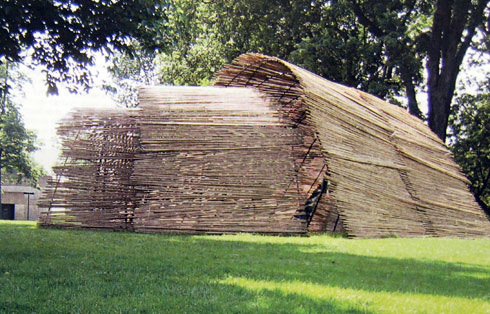
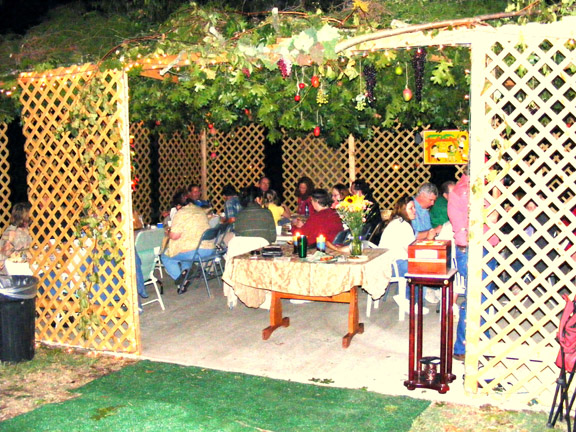
The sukkah itself is temporary structure, usually constructed with wooden or soft fiber walls, and is traditionally used for all meals during the week of the holiday. In warm climates, many people even sleep in their sukkot, making it their home as much as possible for the week.
But how does eating in a hut help us on our journey?
The answer depends upon how one understands the connection between the sukkah of today and the one’s in which those Israelites sat millennia ago.
According to the Talmud, there are two understandings of that connection. One view is that we are recreating today, a version of the actual huts in which the Israelites lived long ago. On this view, the holiday celebrates that we can always find some shelter along the way and that even if the journey is long, we will eventually get there. It’s a message that even today, as we make our own journeys to the promised lands we each pursue, we can help construct the structures that we need on our journeys and that we can celebrate the steps we take along that path even though we have not yet arrived at our desired destination.
The second understanding in the Talmud says that the huts of today recall the “Clouds of Glory” (think Spielberg’s Prince of Egypt or Demille’s Ten Commandments) in which the Israelites lived — that God actually housed people in the protective presence of God’s self. Amazingly, or perhaps not, it is this mystical understanding which is recorded as the normative view and is the one which guides how contemporary sukkot are built. The Sukkah of today is a vision brought to life, of what it means to experience Divine protection. And the defining feature of this construction is that it must have a leaky roof!
That’s right, according to the laws of sukkah-building as recorded in the Jewish legal codes, for a sukkah to be a sukkah, its roof must be able to allow rain in and those inside to see the stars above. In other words, Divine protection is many things, but it does not insulate us from every undesirable thing in the world, nor does it blind us to the beauty of those things which lie beyond it.
The sukkah celebrates being protected but not behind impenetrable walls. It reminds us that permeability is actually a good thing as long as there is not too much vulnerability. The journey will have rainy days, and even if God is providing the cover, we are going too get wet. But when it gets to wet in the sukkah, when it becomes genuinely uncomfortable, one is free to go inside where it’s warm and dry. That’s actually the law.
Successful journeys are not about how much we can endure, and neither is Sukkot. They are about the willingness to set off on an adventure in which we accept that there will bumps in the road and setbacks along the way, but also confident that with that openness, there will be enough protection so that nobody should ever feel entirely vulnerable. And in finding that balance, we can all make the journeys we need to the places we want to go in our lives.
 Read Previous Post