Rabbi Marvin Tokayer is a rabbi with long-held interest in Asia and now that interest includes teaching Talmud to Koreans – almost none of whom have ever met a Jew! Is this crazy or actually quite inspired?
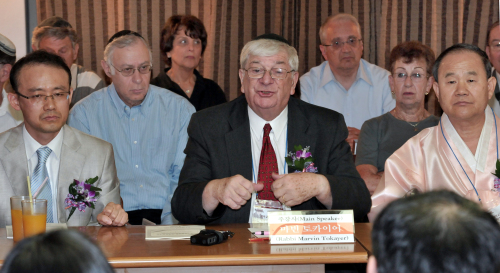
If one assumes that Torah study, and I use the term in the traditional sense to refer to the study of all sacred texts, is actually good for people, then it makes good sense to share the wisdom of the Torah with anybody about whom one cares – not to convert them to Judaism, but to enhance their lives. And that is precisely what rabbi Tokayer is doing.
Having begun his love-affair with Asia when serving there as a member of the United States Air Force, the rabbi has lived in, and written about, Asia for years. But I also appreciate that some of the comments he made at a press conference in Seoul are the reason why many in Asia are deeply suspicious of organized religion of any kind.
“Forty years ago, Korea was very poor and just coming out of the war. Then I sensed the wonderful soul in Korean people and they respected their ancient history. Returning now to Korea, yet I worry that as Korea advances with technology and with the computer, Korea is losing its soul,”
I have no idea if Korea is “losing its soul”, but the move from poverty and powerlessness to prosperity and greater power seems pretty sacred to me. Too often religion is used to bemoan technological and economic progress because with such progress, religious leaders may lose some of their authority.
Instead of helping to create a new ethic for an upgraded reality, religious leaders often choose instead to tell people what they are doing wrong instead. Instead of helping with the move to new empowerment, they bemoan the loss of old structures – hardly a recipe for success.
“Losing its soul” sounds like one more religious type lamenting the quaintness one American enjoyed from the comfort of his air base. The real issue is can Jewish tradition, or any other spiritual tradition, help people to take new prosperity and power and use it well.
And you have to love the irony of a piece in Vos Iz Neias, a hareidi/daas torah news site, which was the source for this story, celebrating the asking of questions as central to religious growth! But that’s another story…


Author, radio and TV talk show host, and President of CLAL-The National Jewish Center for Learning and Leadership, Brad Hirschfield is the author of 


posted August 19, 2010 at 9:46 am
the two japs look so bored I bet if someone threw in a sword there would be some harry carry up among the funny looking jews.
posted August 19, 2010 at 10:59 am
In the oriental cultures it is very bad form to show any emotion in public. Thus the Korean men would not be exhibiting any emotion in their faces, which the uninformed western man might interperate as bordom.
posted August 19, 2010 at 11:19 am
this is nothing more than a corporate take over
posted August 19, 2010 at 7:40 pm
Ummm..Frank, they are KOREAN, not Japanese. Please, spare us your bigotry and ignorance.
Ah, the internet. Maybe it really IS ruining society, or at least, giving the lowest common denominator WAY too much airtime.
And we thought TV was bad.
Interesting article Rabbi. I suspect their culture could benefit from the questioning style of Torah study and our students could benefit from their diligence and work ethic. I taught at a tutoring center that was owned by and catered mostly to Korean and Korean-American students. It was interesting to see how different they and their parents were from my other students.
posted August 20, 2010 at 12:40 pm
Love your observations, Lucy! And you ar so correct about the Korean culture. There is a love of learning this country could emulate, and respect for elders that this country desperately needs to practice. A very interesting view on Talmud study by non-Jews, Rabbi. May they benefit from its wisdom.
posted August 20, 2010 at 1:00 pm
Women in this country need to learn how to submit to men. That is whats needed here now most of all. Wax on wax off now sand the floor.
posted August 22, 2010 at 12:14 am
Thank you rabbi, for an uplifting post!
posted August 22, 2010 at 12:30 pm
Very smart move on behalf of the rabbi, the Christians are next in line to trick the orientals. ask yourself what does the rabbi gain from this deception. Nobody does anything for free anymore.
posted August 31, 2010 at 2:47 am
Rabbi Hirschfield writes: “If one assumes that Torah study … is actually good for people, then it makes good sense to share the wisdom of the Torah with anybody about whom one cares”
This claim requires analysis. Maybe Torah study isn’t actually good for people. Surely our rabbis throughout history believe Torah study is good for Jews, yet many of them have opposed teaching Torah to non-Jews. Why? Well, maybe Torah study IS actually good for non-Jews too, but maybe it doesn’t make good sense to share it with them. I’m just saying “maybe” here. Read on though.
“Rabbi J. David Bleich (Contemporary Halachic Problems 2:16 p311-340):
The prohibition against teaching Torah to non-Jews is well-known to
students of Jewish Iaw. Equally well known is the role of Abraham as the father of the multitude of nations entrusted with the sacred task of carrying the teaching of monotheism to idolatrous people. A person
unfamiliar with the extensive rabbinical literature devoted to his topic may perceive a certain tension, and perhaps even contradiction, between a recognized need to disseminate religious truths and an almost xenophobic reluctance to share the greatest repository of such truth-the Torah. Yet even a cursory examination of the relevant sources dispels the notion that while the community of Israel jealously guards its spiritual wealth, it refuses to share these riches with others. On the contrary, it is unique among western religions in its willingness to share its teachings without seeking to impose its observances.
Nevertheless in some contexts it is permissible to teach Torah to
non-Jews, in others it is even praiseworthy to do so. The matter is
greatly complicated by numerous disagreements between halakhic
authorities with regard to the precise parameters of this prohibition.
Thus numerous scholars permit the study or teaching of the Written Law, others permit forthright responses to inquiries with regard to any facet of Torah study and/or instruction to correct erroneous views, while still others permit the teaching of Torah but not of its secrets or reasons. In the medieval period no less a personage than Rambam entirely excluded Christians from this prohibition, while in the last century R. Israel Salanter, the acclaimed founder of the Mussar movement, actually mounted a campaign for the incorporation of talmudic studies in the curricula of European schools and universities. With regard to some points there emerges a consensus; with regard to others, controversy remains. In order to understand properly how it may be that for some authorities and under conditions an act may constitute a violation of a divine command, while for other authorities or under other circumstances the deed may be meritorious, it is necessary to undertake a careful examination of the halakhic sources.” — From Rabbi Eidensohn