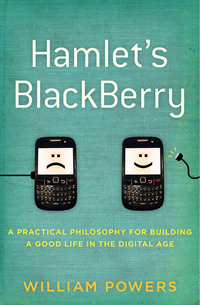
 I heard a terrific NPR interview yesterday with William Powers, author of the new book Hamlet’s BlackBerry: A Practical Philosophy for Building a Good Life in the Digital Age. I can’t wait to read the book, because he’s diagnosing a problem I see in my own life: all of these time-saving methods of communication have made me more busy, not less. Here’s an excerpt about that:
“We’re all busier. Much, much busier. It’s a lot of work managing all
this connectedness. The e-mails, texts, and voicemails; the pokes,
prods, and tweets; the alerts and comments; the links, tags, and posts;
the photos and videos; the blogs and vlogs; the searches, downloads,
uploads, files, and folders; feeds and filters; walls and widgets; tags
and clouds; the usernames, passcodes, and access keys; pop-ups and
banners; ringtones and vibrations. That’s just a small sample of what we
navigate each day in the room. By the time you read this there will be
completely new modes of connecting that are all the rage. Our tools are
fertile, constantly multiplying.
As they
do, so does our busyness. Little by little, our workdays grow more
crowded. When you carry a mobile device, all things digital (and all
people) are along for the ride. Home life is busier too. Much of what
used to be called free time has been colonized by our myriad connective
obligations, and so is no longer free.
It’s
easy to blame all this on the tools. Too easy. These tools are
fantastically useful and enrich our lives in countless ways. Like all
new technologies, they have flaws, but at bottom they can’t make us busy
until we make them busy first. We’re the prime movers here. We’re
always connected because we’re always connecting.”
I used to have very clear limits about my Internet usage. I’d check email for the last time on Saturday night, then shut my computer down until Monday morning. I looked forward to this time to unplug from digital culture, blogs, and work, and was able to have a real Sabbath.
 My walls started cracking when I joined Facebook in 2008; sometimes I would check it on Saturday night or Sunday afternoon. Then I got an iPhone, and suddenly, every possibility was available to me 24/7! I could check my friends’ Facebook statuses or dash off a quick email reply, even if I was out sledding with my family. It seemed like a wonderful invention. Until, suddenly, it didn’t. My Sabbath has not been a real Sabbath for some time now.
The interview hit me at the perfect moment just when I needed a reminder to recommit to a weekly unplugging. I’m returning to a Saturday-night-to-Monday-morning break from tech. (Your prayers are appreciated.)
And I need to go even further. Next week, I’m on a writing retreat to finish my Flunking Sainthood book, and I’m going to put my iPhone in its Airplane mode so I can’t even see the emails as they pop in. I will not be checking the comments on this blog next week (sorry!), though I’m uploading my posts in advance. And I’m only going to use my computer to write, not to surf. My goal by the end of the retreat is to have written two complete chapters and to have enjoyed the luxury of committing many days to the book. Here’s hoping.
What do you do to unplug from the Internet and from email?
 Read Previous Post